
Many PCB manufacturers assume any “high-temperature tape” can survive reflow soldering.
However, in actual SMT production, failure often occurs due to:
Adhesive softening above 240°C
Edge lifting during nitrogen reflow
Silicone bleed contaminating pads
Film shrinkage causing exposure
These are not material defects — they are selection errors.
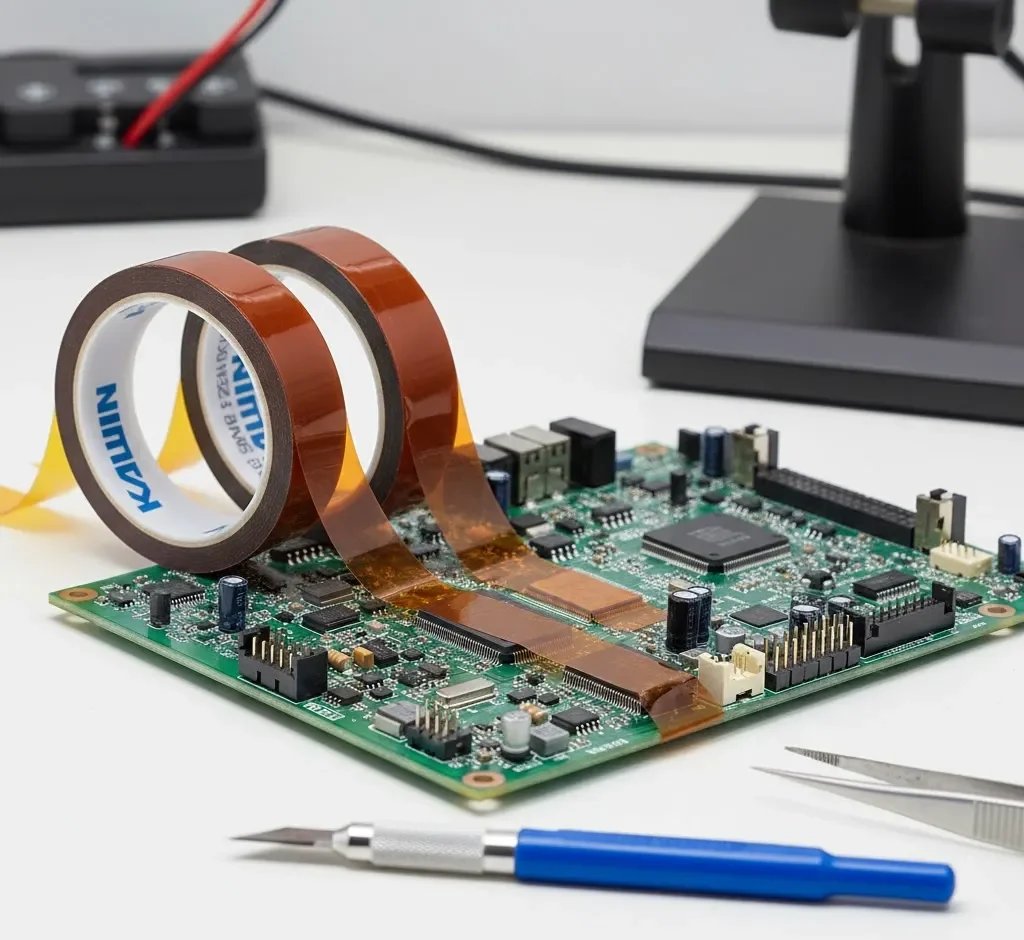
Understanding the Reflow Thermal Profile
Typical lead-free reflow profile:
Preheat: 150–180°C
Soak: 180–220°C
Peak: 245–260°C
Time above 217°C: 60–90 seconds
A Kapton tape used for masking must tolerate:
Short-term 260°C
Rapid temperature ramp
Direct IR heating
Not all polyimide tapes behave the same under these conditions.
Film Thickness vs Adhesive Performance
Engineers often choose thicker film thinking it offers better heat resistance.
In reality:
0.05mm film = better flexibility for tight masking
0.06–0.08mm = more stable edge definition
Excess thickness = increased edge lift risk
Adhesive type is even more critical.
Silicone adhesive offers:
Better high-temperature stability
Clean removal
Minimal residue
But lower initial tack compared to acrylic systems.
Common Selection Mistakes
Using acrylic adhesive for reflow masking
Choosing too wide a roll without edge sealing
Ignoring dielectric requirements for high-voltage PCB
Not testing under real thermal profile
Professional recommendation:
Always validate Kapton tape under actual reflow profile before mass production.
Recommended Kapton Tape Specifications for PCB Masking
Film: Polyimide
Adhesive: High-temperature silicone
Thickness: 0.06mm typical
Dielectric strength: >6kV
Short-term heat resistance: 260–300°C
Clean peel without pad lifting
Where Kapton Tape Is Critical in PCB Production
Gold finger protection
Wave solder pallet masking
Reflow connector shielding
Transformer coil insulation
High-voltage spacing control
FAQ
Can Kapton tape contaminate PCB pads?
Low-quality silicone adhesive may cause transfer. Always test for residue under peak temperature conditions.
Is thicker Kapton tape better for heat resistance?
No. Heat resistance depends on film chemistry, not just thickness.
What is the difference between polyimide tape and Kapton tape?
Kapton is a DuPont polyimide film brand. Industrial “polyimide tape” is the generic term.
CTA
If you are selecting Kapton tape for PCB solder masking or high-temperature insulation,
our engineering team can recommend a suitable grade based on your thermal profile and application method.
Request a technical datasheet or sample for validation testing.