
Release liners—whether film-based or paper-based—are the unsung heroes of the pressure-sensitive adhesive (PSA) industry. They are critical for die-cutting precision, electronics manufacturing, and high-speed labeling. However, even a minor mismatch in surface energy or curing level can lead to costly production downtime.
Drawing on 29 years of expertise in industrial adhesive tapes, KAWIN has synthesized this systematic breakdown of high-frequency release liner issues, supported by international testing standards, to help your engineering teams diagnose and resolve problems instantly.
1. Peeling Abnormalities: When the Liner Won’t Cooperate
1.1 Excessive Release Force (The “Tight Release” Struggle)
The Phenomenon:
High resistance during peeling, often leading to adhesive tearing, substrate deformation, or “ghosting” (adhesive residue) on the liner. In high-speed automated lines, this can cause the liner to snap.
Technical Insight & Root Causes:
Release force is not a static value; it’s a dynamic interaction. According to ASTM D3330 (Standard Test Method for Peel Adhesion), several factors can cause an unexpected spike:
Incomplete Curing: Low crosslink density in the silicone layer leaves it “tacky.”
Mechanical Anchoring: Low-viscosity adhesives migrating into the microscopic pores of the coating.
Environmental Aging: High temperature and pressure during storage (especially in tropical climates) accelerate interfacial interaction.
KAWIN’S Expert Solutions:
Verify Curing: Perform a Residual Adhesion Test (FINAT FTM 11) to ensure the silicone is fully crosslinked.
Material Matching: Ensure your release level (Easy, Medium, or Tight) is specifically calibrated for your adhesive chemistry (Acrylic vs. Silicone-based).
Climate Control: Maintain storage at 20–25°C and 40–60% RH.

1.2 Low Release Force (Premature Release)
The Phenomenon:
Also known as “self-peeling” or “tunneling.” The liner separates during transport or slitting, leading to adhesive contamination and misalignment.
Root Causes:
Over-Curing: Excessive UV or thermal energy causing molecular rearrangement.
Silicone Migration: Unbound silicone molecules migrating to the adhesive surface, killing its tackiness.
Expert Solutions:
Optimize Thermal Profile: Validate curing energy via accelerated aging tests to prevent “over-cooking” the liner.
Tension Management: Reduce slitting and rewinding tension to prevent physical separation.
2. Coating Quality & Contamination Issues
2.1 Silicone Transfer (The Silent Bond Killer)
The Symptom:
Residual silicone on the adhesive surface prevents the final product from sticking to the target substrate or causes printing defects.
Technical Insight:
This is often verified using the FINAT FTM 10 test. If the silicone anchorage is weak, the “release” happens at the liner-silicone interface instead of the adhesive-silicone interface.
Solutions:
Surface Treatment: For PET or PP films, ensure high-level Corona treatment (>42 dyne/cm) before coating to ensure permanent silicone anchorage.
Switch to Non-Silicone: For highly sensitive optical or semiconductor applications, consider Silicone-Free Release Liners.
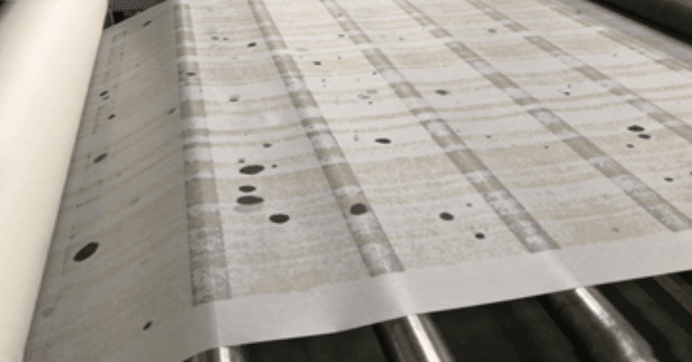
2.2 Uneven Coating (Spotty Release)
Root Causes:
Worn gravure rolls or improper viscosity control during the coating process.
Solutions:
Implement regular equipment maintenance and use X-ray fluorescence (XRF) to monitor coating weight consistency across the web.
3. Physical & Converting Challenges
3.1 Static Electricity in Film Liners
The Issue:
PET and PP films are notorious for static buildup, attracting dust and causing “shocks” to operators or sensitive electronic components.
Pro-Tech Solution:
Specify Anti-Static (ESD) treated liners for cleanroom environments.
Maintain humidity levels above 40% RH in the converting area.
3.2 Curling and Warping
Root Causes:
Mainly affects Release Paper. Moisture absorption causes the paper fibers to swell while the adhesive stays rigid, leading to “curling.”
Solutions:
Use PE-Coated Kraft (PEK) or High-Density Glassine for better moisture barriers.
Ensure tension balance between the face material and the liner during lamination.
4. Material Selection Guide: Film vs. Paper
| Property | Release Paper (Glassine/CCK) | Release Film (PET/PP/PE) |
| Cost | Cost-effective for high-volume | Premium investment |
| Flatness | Moderate (may have fiber texture) | Excellent (Optical Grade) |
| Cleanliness | Potential for fiber shedding | High (Cleanroom Compatible) |
| Durability | Sensitive to humidity | Moisture & Chemical resistant |
| Best For | General labels, logistics | Electronics, Medical, Precision Die-cutting |
Conclusion: Prevention is Cheaper than Correction
Selecting the right release liner is a balance of chemistry, physics, and cost. By implementing a First-In, First-Out (FIFO) inventory system and conducting incoming QC based on ASTM and FINAT standards, you can eliminate 90% of peeling abnormalities.
Need a Professional Grade Audit?
At KAWIN, we don’t just supply tape; we provide structural bonding solutions. If you are facing “Peel Drift” or “Silicone Transfer” issues in your current production, contact our engineering team today for a customized technical consultation.
References:
ASTM D3330 – Standard Test Method for Peel Adhesion.
FINAT Technical Handbook – Testing Methods for Self-Adhesive Materials.