
Root Causes and Professional Solutions
Fraying edges, loose fibers, fuzzing, and uneven cutting are common quality complaints in hook and loop fasteners.
If not properly controlled, these issues affect product appearance, durability, and customer satisfaction.
This guide explains the real production-level causes behind edge fraying — in a way that production teams, procurement managers, and quality inspectors can all understand.
1. Core Reasons Why Hook and Loop Edges Fray
1️⃣ Raw Material Problems
The most fundamental issue often starts with the yarn.
Common material defects:
Low yarn twist → weak fiber cohesion → fibers separate easily
Low tensile strength yarn → breaks during cutting
Use of recycled materials → brittle fibers that snap and fuzz
Uneven polyester/nylon filament thickness → loose edge structure after weaving
When the fiber quality is unstable, no cutting method can completely prevent edge fuzzing.
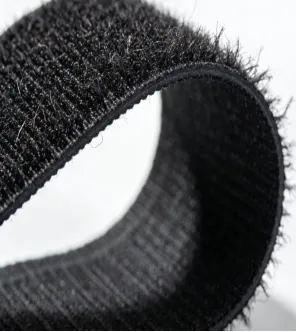
2️⃣ Weaving Process Issues (Loose Construction)
If the tape structure is too soft or poorly tensioned, fraying becomes unavoidable.
Typical weaving defects:
Low weave density (low stitch count) → weak edge support
Unstable warp & weft tension → uneven surface
Poor mold precision in hook/loop formation → irregular edge fiber protrusion
A loosely woven tape lacks structural “backbone,” so cutting exposes unstable fibers.
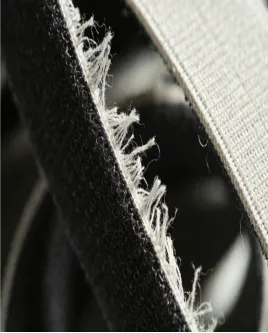
3️⃣ Slitting & Cutting Problems (Most Common Cause)
In our factory experience, over 60% of edge-fraying complaints originate from improper cutting.
Typical cutting mistakes:
Dull blades → fibers are torn, not cleanly cut → immediate fuzzing
High slitting speed + unstable pressure rollers → tape vibration → uneven edges
Cold cutting only (no heat sealing) → polyester/nylon fibers unravel instantly
Synthetic fibers like nylon and polyester must be heat-sealed to prevent fraying.
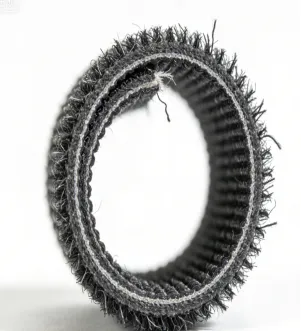
4️⃣ Insufficient Post-Treatment
Edge finishing is critical for long-term performance.
Missing processes may include:
Heat cutting
Ultrasonic cutting
Edge sealing
Thermal setting
Without fiber fusion at the edge, slight friction during use will cause fuzzing and fiber separation.
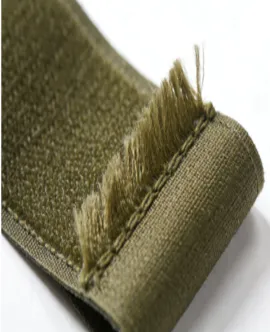
5️⃣ Usage & Environmental Factors
Sometimes fraying is not a manufacturing defect but a durability limitation.
Repeated pulling and friction
Frequent washing
High temperature exposure
UV aging
These conditions accelerate fiber fatigue and edge breakdown.
2. How to Quickly Diagnose the Problem
You can often identify the root cause with a simple observation:
| Symptom | Likely Cause |
|---|---|
| Fibers scatter immediately after tearing | Poor raw material or loose weaving |
| Cut edge looks rough with pulled filaments | Dull blade or cold cutting |
| Only frays after long-term use | Normal wear or low abrasion resistance |
3. Practical Solutions to Eliminate Fraying
Based on production experience, the following solutions are most effective:
✅ 1. Use Heat Cutting or Ultrasonic Cutting
This melts and seals synthetic fibers at the edge, preventing unraveling.
✅ 2. Replace Blades Regularly
Sharp blades ensure clean fiber separation instead of tearing.
✅ 3. Choose High-Density Weaving
Higher stitch count improves edge integrity and structural stability.
✅ 4. Require Edge Finishing
Ask suppliers about:
Heat sealing
Edge binding
Lock stitching
Thermal shaping
✅ 5. For High-End Applications
Consider:
Injection molded hooks
Ultra-thin edge-sealed types
High abrasion-resistant nylon grades
4. Application-Based Recommendations
Different industries require different solutions:
Footwear → High abrasion resistance + heat-sealed edges
Luggage & bags → Dense weaving + ultrasonic cutting
Medical use → Soft edge finishing + lint-resistant material
Home textiles → Wash-resistant + thermal setting
Industrial use → High tensile nylon + injection hook
Selecting the correct structure from the beginning prevents 90% of fraying issues.
Conclusion
Edge fraying in hook and loop fasteners is rarely caused by a single factor.
It is usually a combination of:
Material quality
Weaving density
Cutting method
Post-treatment
Application environment
Understanding the root cause allows you to specify the right product and avoid repeated quality complaints.