
What Is the Most Important Factor When Selecting a Tackifier Resin?
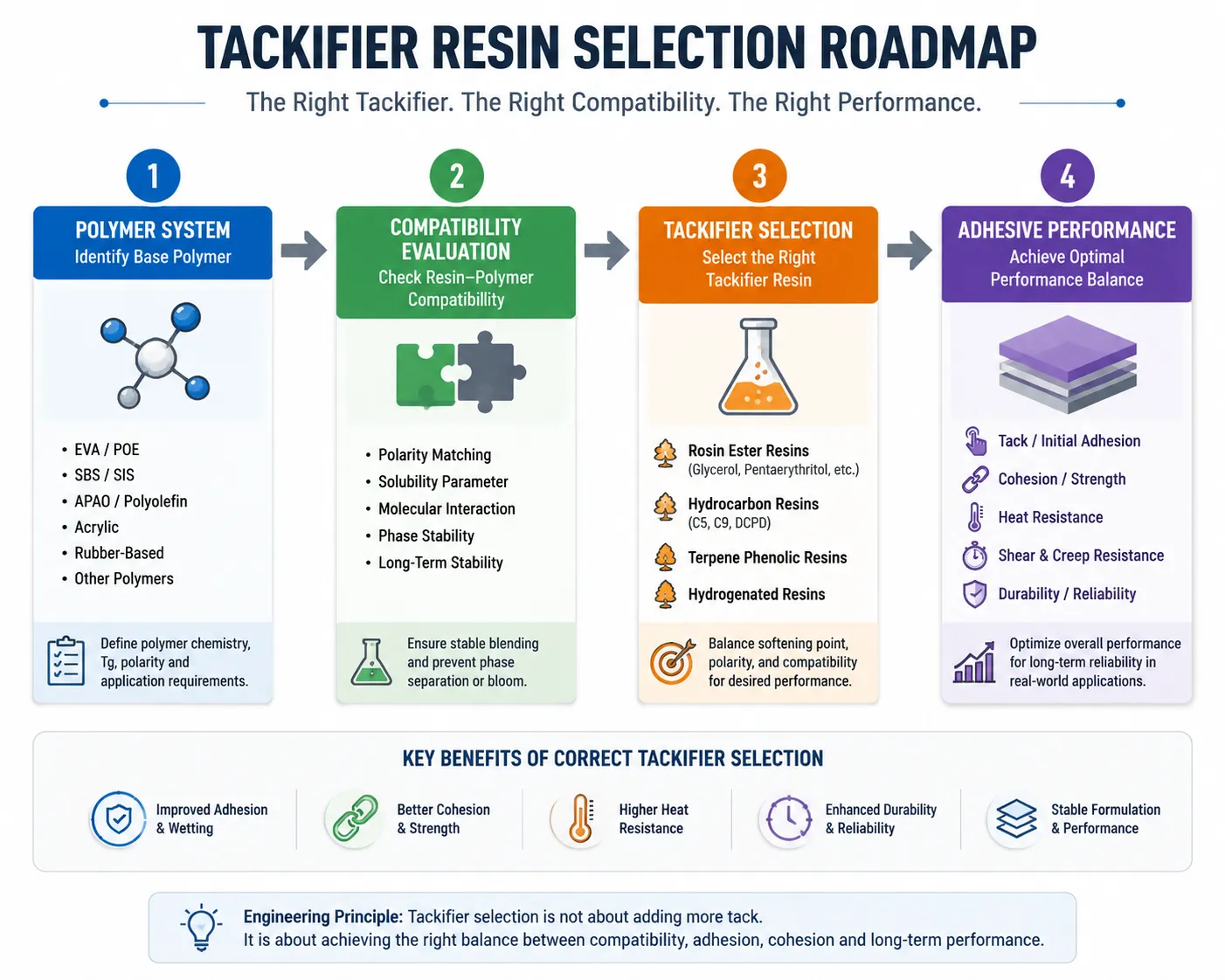
Tackifier resin selection is not simply about increasing adhesive tack. The correct resin must balance softening point, glass transition temperature, polarity, compatibility, and long-term stability with the base polymer. A resin that improves initial adhesion may reduce heat resistance or cohesion if it is incompatible with the adhesive system.
For hot melt adhesives, resin softening point strongly influences high-temperature performance. For pressure-sensitive adhesives, tackifiers mainly adjust the viscoelastic balance between tack, peel adhesion, shear resistance, and cohesion.
The best tackifier is therefore determined by three factors:
- Polymer compatibility
- Required performance balance
- Application environment
Key Takeaways
- Tackifier resin structure determines compatibility, heat resistance, and adhesive performance.
- A higher softening point does not automatically mean a better adhesive.
- Rosin esters provide strong wetting and polarity, while hydrocarbon resins offer excellent compatibility with non-polar polymers.
- Hydrogenation improves oxidation resistance and long-term stability.
- Tackifier selection must consider the polymer system, not only the resin itself.
- Adhesive failures often result from incorrect resin-polymer matching rather than poor manufacturing processes.
Table of Contents
- A Real Adhesive Failure Caused by Incorrect Tackifier Selection
- What Are Tackifier Resins and Why Do They Matter?
- Four Major Tackifier Resin Families
- How Molecular Structure Controls Resin Performance
- Tackifier Compatibility: Why Some Resins Work and Others Fail
- How Tackifiers Modify Pressure-Sensitive Adhesives
- How Tackifiers Function in Hot Melt Adhesives
- Hydrogenated vs Non-Hydrogenated Tackifier Resins
- Four Common Tackifier Selection Failures
- Practical Tackifier Selection Guide by Polymer System
- Engineering Framework for Selecting the Right Tackifier
Chapter 1 A Real Adhesive Failure Caused by Incorrect Tackifier Selection
Quick Answer:
A tackifier resin that is poorly matched to the adhesive system can cause complete bond failure even when the polymer, coating process, and application method appear correct. In high-temperature applications, the tackifier softening point and compatibility with the base polymer are critical factors controlling long-term adhesive reliability.
A 15°C Difference in Softening Point Caused a Production Failure
An automotive interior component manufacturer experienced large-scale adhesive failure during thermal aging testing.
The application used an EVA hot melt adhesive to bond interior plastic components. After exposure to an 85°C heat aging condition, large areas of the bonded parts detached from the substrate.
The initial investigation focused on common process factors:
- Incorrect adhesive application temperature
- Insufficient bonding pressure
- Improper surface preparation
- Incorrect EVA polymer grade
However, the actual cause was not the polymer itself. The failure originated from an unsuitable tackifier resin selection.
Root Cause: The Tackifier Softening Point Was Too Close to the Service Temperature
The adhesive formulation used glycerol ester of rosin (GER) as the tackifier.
GER provides excellent initial adhesion because its polar ester groups improve wetting and interaction with many polar polymers. However, its softening point is typically around 85°C, which was too close to the actual service temperature.
When the operating temperature approaches the tackifier softening point, several performance changes occur:
- The resin phase becomes softer
- Adhesive modulus decreases
- Creep resistance is reduced
- Internal cohesion becomes weaker
As a result, the adhesive layer can no longer maintain mechanical stability under thermal stress, leading to bond failure.
Why Higher Temperature Applications Require Tackifier Selection Beyond Initial Adhesion
A common mistake in adhesive formulation is selecting a tackifier only because it provides strong initial bonding.
However, industrial adhesive performance requires balancing:
| Performance Requirement | Why It Matters |
|---|---|
| Initial tack | Allows fast contact and wetting |
| Cohesion | Prevents internal adhesive failure |
| Heat resistance | Maintains bonding strength during thermal exposure |
| Compatibility | Prevents phase separation and instability |
The correct tackifier is therefore not simply the resin with the highest tack. It is the resin that provides the required balance between adhesion, cohesion, processing behavior, and service temperature performance.
Engineering Solution: Selecting a Higher-Temperature Tackifier System
The adhesive performance was improved by replacing the lower-temperature tackifier system with a higher-temperature resin selection, such as:
- Pentaerythritol rosin ester (PER)
- Hydrogenated rosin ester
- Terpene phenolic resin
These resin systems provide improved resistance against thermal softening and maintain adhesive strength under higher service temperatures.
Key Engineering Lesson
Tackifier selection directly influences adhesive reliability. A resin that performs well at room temperature may fail when exposed to elevated temperatures if its thermal characteristics do not match the application requirements.
The first question in tackifier selection should not be:
“Which resin provides the strongest tack?”
It should be:
“Which resin provides the correct balance of compatibility, adhesion, cohesion, and durability for this application?”
Chapter 2 What Are Tackifier Resins and Why Do They Matter?
Quick Answer:
Tackifier resins are low molecular weight materials added to adhesive formulations to improve wetting, adhesion, and bonding performance. They work by modifying polymer mobility, surface interaction, and viscoelastic behavior, allowing adhesives to achieve the right balance between stickiness and mechanical strength.
A tackifier does not simply make an adhesive “more sticky”. Its real function is to adjust how the adhesive flows, bonds, and resists stress during application and service.
What Is a Tackifier Resin?
A tackifier resin is a relatively low molecular weight resin used as a functional component in adhesive formulations.
Unlike the main polymer, which provides the basic mechanical structure of the adhesive, tackifiers are primarily used to modify adhesive behavior.
Common tackifier families include:
- Rosin ester resins
- Hydrocarbon resins
- Terpene resins
- Hydrogenated tackifier resins
These materials are widely used in:
- Pressure-sensitive adhesives (PSA)
- Hot melt adhesives (HMA)
- Rubber-based adhesives
- Industrial adhesive tapes
Why Adhesive Polymers Need Tackifiers
The base polymer provides strength, elasticity, and durability, but it does not always provide sufficient surface contact or bonding efficiency.
For example, many high molecular weight polymers have excellent mechanical strength but limited ability to quickly flow and wet a surface.
A tackifier modifies this balance by improving:
| Function | Effect on Adhesive Performance |
|---|---|
| Improved wetting | Allows adhesive molecules to contact the substrate more effectively |
| Increased molecular mobility | Improves initial bonding and surface contact |
| Modified viscoelastic behavior | Balances tack, peel, and shear performance |
| Controlled rigidity | Improves holding strength and temperature resistance |
How Tackifiers Change Adhesive Behavior
The main role of a tackifier is to modify the relationship between adhesive flow and adhesive strength.
An adhesive must satisfy two opposite requirements:
- Flow ability: The adhesive must deform enough to wet the surface.
- Structural strength: The adhesive must resist deformation after bonding.
If the adhesive is too rigid, it cannot properly contact the substrate.
If the adhesive is too soft, it may creep, flow, or lose holding power.
Tackifier selection helps move the adhesive into the appropriate performance window.
The Relationship Between Polymer and Tackifier
A tackifier never works independently. Its performance depends on the interaction between the resin and the base polymer.
The same tackifier can produce completely different results in different adhesive systems.
| Polymer System | Typical Tackifier Direction | Main Reason |
|---|---|---|
| EVA | Rosin ester | Good interaction with polar vinyl acetate segments |
| SIS/SBS | C5 hydrocarbon, terpene resin | Compatibility with rubber phase |
| APAO | Hydrocarbon resin | Better match with non-polar structure |
| Acrylic PSA | Hydrogenated tackifier | Improved aging stability and compatibility |
Why Tackifier Selection Is a Formulation Decision
Choosing a tackifier is not simply selecting the resin with the highest adhesion value.
A successful formulation requires understanding:
- Polymer chemistry
- Resin compatibility
- Application temperature
- Required adhesion level
- Long-term durability requirements
For this reason, professional adhesive development treats tackifier selection as a system-level engineering decision rather than a single material choice.
Engineering Insight
The purpose of a tackifier is not to maximize stickiness. Its purpose is to create the correct balance between surface wetting, molecular interaction, and mechanical stability.
The best tackifier is therefore the one that works together with the polymer system to achieve predictable adhesive performance under real application conditions.
Chapter 3 Four Major Tackifier Resin Families
Quick Answer:
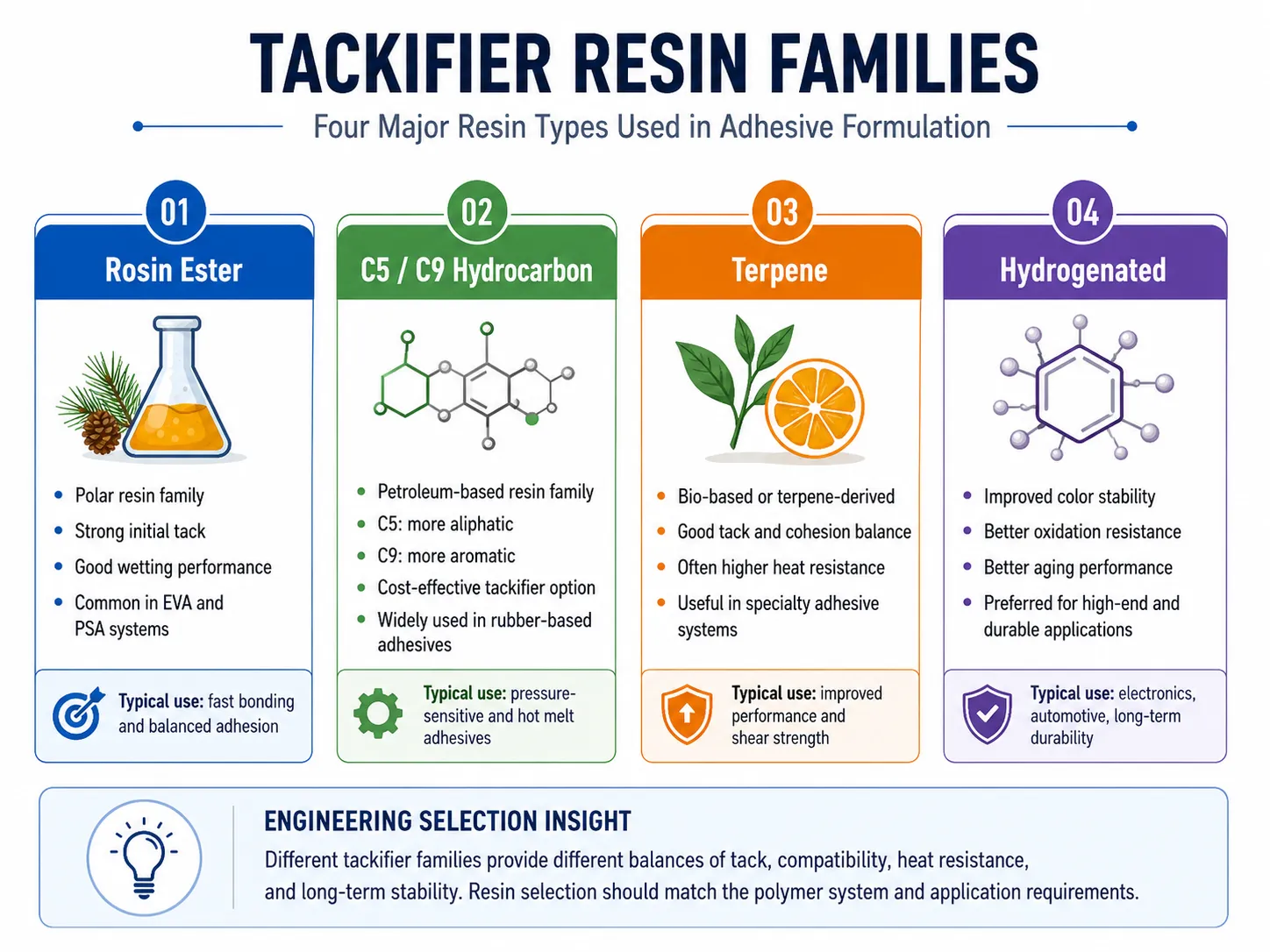
The four major tackifier resin families used in industrial adhesives are rosin ester resins, hydrocarbon resins, terpene resins, and hydrogenated tackifier resins. Each family provides different advantages in polarity, compatibility, thermal stability, and aging resistance, making them suitable for different adhesive polymer systems.
The correct choice depends not on which resin has the highest tack, but on how well the resin matches the adhesive polymer and the required application conditions.
Overview of Major Tackifier Resin Families
| Tackifier Family | Main Advantage | Typical Applications | Main Limitation |
|---|---|---|---|
| Rosin Ester Resin | Excellent polarity and strong initial tack | EVA, acrylic PSA, rubber adhesives | Lower oxidation resistance without hydrogenation |
| Hydrocarbon Resin (C5/C9) | Good balance of tack, cost and compatibility | SIS/SBS, packaging adhesives, hot melt adhesives | Performance depends strongly on polymer compatibility |
| Terpene Resin | High Tg and strong cohesive contribution | High shear applications, difficult bonding systems | Higher cost compared with commodity resins |
| Hydrogenated Tackifier Resin | Excellent aging, color stability and oxidation resistance | Electronics, medical, outdoor applications | Higher material cost |
Rosin Ester Tackifiers: High Polarity and Strong Adhesion
Rosin ester resins are among the most widely used tackifiers because their ester functional groups provide strong interaction with polar adhesive polymers.
They are commonly selected for systems such as:
- EVA hot melt adhesives
- Acrylic pressure-sensitive adhesives
- Rubber-based adhesives
The main advantages of rosin ester tackifiers include:
- Excellent surface wetting
- High initial tack
- Good adhesion to polar substrates
However, non-hydrogenated rosin ester systems may have limitations in applications requiring long-term thermal and oxidative stability.
Hydrocarbon Resins: Flexible Performance and Broad Compatibility
Hydrocarbon resins are synthetic tackifiers mainly produced from petroleum-derived feedstocks.
The two common categories are:
| Resin Type | Structure Characteristics | Typical Function |
|---|---|---|
| C5 Hydrocarbon Resin | Aliphatic structure | Improves tack and flexibility |
| C9 Hydrocarbon Resin | Aromatic structure | Improves hardness, stiffness and heat resistance |
C5 Hydrocarbon Resin
C5 resins are commonly used where fast wetting and high tack are required.
Typical applications include:
- SIS/SBS pressure-sensitive adhesives
- Rubber-based adhesive systems
- General-purpose hot melt adhesives
Their limitation is that they may provide insufficient high-temperature performance in demanding applications.
C9 Hydrocarbon Resin
C9 resins contain more aromatic structures, which generally provide higher rigidity and stronger cohesive contribution.
They are often considered when higher temperature resistance or mechanical reinforcement is required.
However, excessive aromatic character may reduce compatibility with some polymer systems.
Terpene Resins: High Performance for Demanding Applications
Terpene resins are derived from natural terpene compounds and are known for their rigid molecular structure and relatively high glass transition temperature.
Their key advantages include:
- High cohesive strength
- Good resistance to creep
- Improved performance at elevated temperatures
Terpene resins are often used when an adhesive requires a stronger balance between tack and holding power.
Modified terpene phenolic resins can provide additional polarity and improved bonding to difficult substrates.
Hydrogenated Tackifier Resins: Designed for Long-Term Stability
Hydrogenation reduces the reactive unsaturated bonds in tackifier molecules, improving resistance to oxidation and environmental aging.
Hydrogenated tackifiers are commonly selected for applications requiring:
- Low color change
- UV resistance
- Long-term durability
- Stable performance under heat exposure
Typical applications include:
- Electronic adhesive tapes
- Medical adhesive products
- Outdoor bonding applications
How Engineers Select Between Tackifier Families
| Main Requirement | Preferred Tackifier Direction |
|---|---|
| Maximum initial tack | Rosin ester or C5 resin |
| High temperature resistance | Hydrogenated resin, terpene phenolic, high softening point resin |
| Non-polar polymer systems | C5 hydrocarbon or hydrogenated hydrocarbon resin |
| Long-term outdoor durability | Hydrogenated tackifier |
| High shear resistance | Terpene resin or rigid aromatic resin |
Engineering Insight
No tackifier resin is universally superior. Each resin family represents a different balance between adhesion, cohesion, compatibility, processing behavior, and durability.
The correct selection starts with the adhesive polymer system and application requirements, not with the resin itself.
Chapter 4 How Molecular Structure Controls Resin Performance
Quick Answer:
The performance of a tackifier resin is determined by its molecular structure. Factors such as polarity, glass transition temperature (Tg), molecular rigidity, and chemical stability directly influence compatibility, adhesion, cohesion, heat resistance, and aging performance.
Understanding the relationship between resin structure and adhesive behavior allows engineers to select tackifiers based on performance requirements instead of trial-and-error testing.
The Connection Between Molecular Structure and Adhesive Performance
A tackifier resin is not simply a material that increases stickiness. Its molecular structure determines how it interacts with the base polymer and how the final adhesive behaves under different conditions.
The most important structural factors include:
| Molecular Feature | Effect on Adhesive Performance |
|---|---|
| Higher polarity | Improves interaction with polar polymers and substrates |
| Higher Tg | Improves temperature resistance and reduces creep |
| More rigid molecular structure | Increases cohesion and mechanical strength |
| Hydrogenated structure | Improves oxidation resistance and long-term stability |
| Lower molecular weight | Improves polymer mobility and wetting ability |
How Glass Transition Temperature (Tg) Influences Tackifier Performance
Glass transition temperature (Tg) is one of the most important indicators for understanding tackifier behavior.
Tg represents the temperature range where a polymer or resin changes from a rigid glassy state to a softer rubber-like state.
In adhesive systems, Tg affects the balance between:
- Surface wetting ability
- Initial tack
- Cohesion strength
- Temperature resistance
Low Tg Tackifiers
Lower Tg resins generally provide higher molecular mobility and better wetting ability.
Advantages:
- Fast surface contact
- Improved initial tack
- Better flexibility
Limitations:
- Lower heat resistance
- Higher risk of creep under load
High Tg Tackifiers
Higher Tg resins provide greater rigidity and stronger resistance against deformation.
Advantages:
- Improved shear resistance
- Better high-temperature performance
- Reduced adhesive flow
However, excessive rigidity may reduce wetting ability if the resin is not properly balanced with the polymer system.
How Polarity Determines Resin Compatibility
Compatibility between tackifier and polymer is largely controlled by molecular interactions.
Polar resins tend to interact better with polar polymers, while non-polar resins usually perform better in non-polar systems.
| Material Characteristic | Typical Compatible System |
|---|---|
| Polar tackifiers | EVA with higher vinyl acetate content, acrylic polymers |
| Non-polar hydrocarbon resins | APAO, SIS/SBS rubber systems |
| Modified polar resins | Difficult substrates requiring stronger interaction |
Poor polarity matching can lead to:
- Phase separation
- Reduced adhesive stability
- Resin migration
- Loss of bonding performance
Why Molecular Rigidity Improves Holding Power
The rigidity of a tackifier molecule affects how effectively it reinforces the adhesive structure.
Rigid molecular structures generally increase:
- Elastic modulus
- Cohesive strength
- Resistance to deformation
For applications involving continuous load, vibration, or elevated temperature, higher rigidity can improve long-term holding performance.
However, excessive rigidity may reduce the adhesive’s ability to flow and wet rough surfaces.
Hydrogenation and Chemical Stability
Hydrogenation modifies tackifier chemistry by reducing reactive unsaturated bonds.
This structural change improves:
- Oxidation resistance
- Color stability
- UV resistance
- Long-term aging performance
This is why hydrogenated tackifiers are commonly selected for demanding applications such as electronics, medical products, and outdoor adhesive systems.
Structure–Performance Relationship of Common Tackifier Types
| Tackifier Type | Structural Characteristic | Performance Result |
|---|---|---|
| Rosin Ester | Polar ester groups | High tack and strong interaction with polar polymers |
| C5 Hydrocarbon Resin | Aliphatic structure | Fast wetting and flexible adhesion |
| C9 Hydrocarbon Resin | Aromatic structure | Higher rigidity and reinforcement |
| Terpene Resin | Rigid cyclic structure | Higher Tg and improved shear resistance |
| Hydrogenated Resin | Reduced unsaturation | Improved aging and thermal stability |
Engineering Insight
The performance of a tackifier resin is a direct result of its molecular design.
A successful adhesive formulation does not choose a resin only because it has high tack or high softening point. It selects a resin whose molecular structure matches the polymer system, application environment, and required performance balance.
The fundamental rule is:
Molecular Structure → Compatibility → Adhesive Behavior → Application Performance
Chapter 5 Tackifier Compatibility: Why Some Resins Work and Others Fail
Quick Answer:
Tackifier compatibility is one of the most important factors determining adhesive performance. A resin with excellent tack, high softening point, or strong adhesion can still cause adhesive failure if it is not compatible with the base polymer system.
Successful tackifier selection starts with polymer-resin compatibility before optimizing adhesion, heat resistance, or cost.
Why Compatibility Matters More Than Individual Resin Performance
A common mistake in adhesive formulation is evaluating tackifier performance independently.
For example, a resin may provide:
- High initial tack
- High glass transition temperature
- Good heat resistance
However, if the resin does not interact properly with the adhesive polymer, the final system may suffer from:
- Phase separation
- Resin migration
- Reduced adhesion
- Loss of mechanical stability
- Poor aging performance
The best tackifier is therefore not the resin with the strongest individual properties, but the resin that creates the best interaction with the polymer system.

The Basic Principle of Polymer-Tackifier Compatibility
Compatibility describes how well a tackifier can mix and interact with the adhesive polymer at the molecular level.
A compatible tackifier can:
- Distribute uniformly throughout the polymer matrix
- Modify viscoelastic behavior predictably
- Improve adhesion without damaging cohesion
An incompatible tackifier may create a separated structure where the resin and polymer behave as independent phases.
Solubility Parameter: The First Compatibility Screening Tool
One common method for estimating compatibility is comparing solubility parameters.
Materials with similar molecular interaction characteristics are more likely to form stable mixtures.
| Material | Typical Compatibility Direction |
|---|---|
| Polar tackifiers | Better with polar polymers |
| Hydrocarbon resins | Better with non-polar polymers |
| Modified resins | Used when stronger interaction is required |
However, compatibility is not determined by one parameter alone. Molecular structure, phase behavior, and processing conditions also influence final performance.
Polymer-Tackifier Compatibility Matrix
The following table provides a practical engineering direction for common adhesive systems.
| Polymer System | Preferred Tackifier Family | Reason |
|---|---|---|
| EVA (High VA Content) | Rosin ester, hydrogenated rosin ester | Good polarity matching with vinyl acetate groups |
| EVA (Lower VA Content) | C5 hydrocarbon, selected blends | Better balance with lower polarity polymer structure |
| SIS / SBS | C5 hydrocarbon resin, terpene resin | Good interaction with rubber phase |
| APAO | C5 hydrocarbon resin, hydrogenated hydrocarbon resin | Better compatibility with non-polar polyolefin structure |
| Acrylic PSA | Hydrogenated rosin ester, specialty tackifiers | Improved stability and aging resistance |
What Happens When Tackifier Compatibility Fails?
Failure Mode 1: Phase Separation
When a tackifier cannot properly mix with the polymer, the adhesive may develop microscopic or visible phase separation.
Possible results:
- Uneven adhesive properties
- Reduced bond strength
- Appearance defects
Failure Mode 2: Resin Migration
Poor compatibility can allow low molecular weight resin components to move through the adhesive layer over time.
This may cause:
- Surface contamination
- Reduced adhesion
- Changes in adhesive hardness
Failure Mode 3: Performance Loss During Aging
A formulation that performs well initially may fail after heat, humidity, or long-term storage exposure if the resin-polymer interaction is unstable.
Why the Same Tackifier Can Work in One Adhesive but Fail in Another
Tackifier performance depends on the complete adhesive system.
For example:
- A rosin ester may provide excellent tack in EVA because of favorable polarity interaction.
- The same resin may create instability in a non-polar APAO system.
- A hydrocarbon resin may perform well in SBS but provide limited benefit in highly polar polymers.
This is why tackifier selection cannot be separated from polymer chemistry.
Engineering Compatibility Evaluation Process
- Identify the base polymer
Determine whether the system is polar, non-polar, rubber-based, or acrylic-based. - Select compatible resin families
Eliminate tackifiers with poor molecular matching. - Evaluate physical behavior
Check viscosity, phase stability, and thermal behavior. - Validate through testing
Confirm peel, shear, tack, aging, and environmental performance.
Engineering Insight
Compatibility is the foundation of tackifier selection.
A high-performance resin cannot improve an adhesive system if it cannot properly interact with the polymer matrix.
The correct selection sequence is:
Polymer System → Compatibility → Performance Requirement → Tackifier Selection → Validation Testing
Chapter 6 How Tackifiers Modify Pressure-Sensitive Adhesives
Quick Answer:
In pressure-sensitive adhesives, tackifiers modify adhesive performance by changing polymer mobility, surface wetting behavior, and viscoelastic balance. They can improve initial tack and peel adhesion, but excessive or incompatible tackifier addition may reduce shear strength and long-term holding performance.
The function of a tackifier in PSA formulation is not simply increasing stickiness. Its purpose is to adjust the adhesive into the optimal balance between flow behavior and mechanical resistance.
The Role of Tackifiers in PSA Formulation
Pressure-sensitive adhesives require two opposite characteristics:
- Soft and mobile behavior: allowing the adhesive to flow and wet the substrate surface.
- Strong internal structure: allowing the adhesive to resist deformation after bonding.
The base polymer alone often cannot provide the ideal balance between these requirements.
Tackifiers are added to adjust polymer behavior by:
- Increasing molecular mobility
- Improving surface contact
- Changing viscoelastic properties
- Adjusting adhesion and cohesion balance
How Tackifiers Influence Tack, Peel, Shear and Cohesion
| Performance Property | Effect of Tackifier Addition | Engineering Consideration |
|---|---|---|
| Tack | Usually increases due to improved wetting and molecular contact | Too much tackifier may reduce structural strength |
| Peel Adhesion | Often improves through better interfacial interaction | Depends on substrate and polymer compatibility |
| Shear Resistance | May decrease if adhesive becomes too soft | Requires sufficient cohesion |
| Cohesion | Controlled by resin rigidity and polymer network | Critical for long-term reliability |
Why Increasing Tackifier Content Does Not Always Improve Adhesion
A common formulation mistake is assuming that more tackifier will always create stronger adhesion.
In reality, increasing tackifier concentration usually creates a trade-off:
| Increasing Tackifier Level | Typical Effect |
|---|---|
| Low addition level | Improved wetting and initial adhesion |
| Moderate addition level | Balanced tack and adhesion performance |
| Excessive addition level | Reduced cohesion, creep resistance and heat stability |
The optimum tackifier concentration depends on polymer type, resin chemistry, molecular weight, and application requirements.
The Relationship Between Tackifiers and Viscoelastic Behavior
The performance of PSA materials is strongly related to their viscoelastic properties.
A pressure-sensitive adhesive must maintain a suitable balance between:
- Viscous behavior: enabling surface wetting and bonding.
- Elastic behavior: providing resistance against stress and deformation.
Tackifiers modify this balance by changing polymer mobility and the adhesive’s molecular environment.
Effect on Storage Modulus (G’)
Adding compatible tackifiers generally lowers the effective modulus of the adhesive system, allowing improved contact with rough or uneven surfaces.
However, excessive reduction in modulus may cause:
- Creep under load
- Poor shear holding performance
- Bond failure at elevated temperature
Effect on Loss Modulus (G”)
Tackifier selection also influences energy dissipation during deformation.
Properly selected tackifiers increase the adhesive’s ability to absorb stress while maintaining sufficient recovery behavior.
Different Tackifier Families Create Different PSA Behaviors
| Tackifier Type | Typical PSA Effect |
|---|---|
| Rosin Ester | High tack and strong interfacial adhesion |
| C5 Hydrocarbon Resin | Fast wetting and flexible bonding |
| Terpene Resin | Higher rigidity and improved shear resistance |
| Hydrogenated Resin | Better aging stability and long-term reliability |
Why PSA Applications Require Different Tackifier Strategies
The optimal tackifier depends on the application requirement.
| Application Requirement | Tackifier Direction |
|---|---|
| Fast bonding and high initial tack | Rosin ester or C5 resin |
| High shear holding | Higher Tg resin or terpene-based system |
| Outdoor durability | Hydrogenated tackifier |
| Low surface energy substrates | Modified polar tackifier systems |
| High temperature PSA | High softening point and stable resin systems |
Engineering Insight
In PSA formulation, tackifiers are performance modifiers rather than simple adhesion boosters.
The correct tackifier improves bonding by creating the right relationship between:
Surface Wetting + Molecular Interaction + Cohesive Strength + Environmental Stability
A successful PSA formulation does not maximize tack. It engineers the correct viscoelastic balance required for the final application.
Chapter 7 How Tackifiers Function in Hot Melt Adhesives
Quick Answer:
In hot melt adhesives, tackifiers perform two critical functions: they reduce melt viscosity during processing to improve wetting and flow, and they contribute to final adhesive strength after cooling by modifying the solid-state structure of the adhesive.
Unlike pressure-sensitive adhesives, hot melt adhesives rely on a melt-process-and-solidify mechanism. Therefore, tackifier selection must consider both processing behavior and final bond performance.
The Different Role of Tackifiers in Hot Melt Adhesives
In hot melt adhesive systems, bonding occurs through a different mechanism compared with pressure-sensitive adhesives.
The adhesive is first heated until it becomes a low-viscosity melt. During application, the molten adhesive spreads across the substrate surface and creates contact. After cooling, the adhesive solidifies and develops mechanical strength.
Therefore, tackifiers influence two different stages:
| Stage | Tackifier Function |
|---|---|
| Molten processing stage | Reduce viscosity and improve flow and substrate wetting |
| Solidified bonding stage | Modify hardness, cohesion and temperature resistance |
Stage 1: Improving Melt Flow and Surface Wetting
During hot melt processing, the adhesive must flow sufficiently to contact the substrate surface.
Poor melt flow can result in:
- Incomplete surface contact
- Weak bonding areas
- Poor adhesion strength
Tackifiers improve processability by reducing the effective viscosity of the polymer system.
This allows the adhesive to:
- Spread more easily
- Fill surface irregularities
- Create better molecular contact with the substrate
Stage 2: Improving Final Bond Performance After Cooling
After cooling, the tackifier becomes part of the solid adhesive structure.
Its molecular characteristics influence:
- Adhesive hardness
- Cohesion strength
- Heat resistance
- Creep resistance
A low softening point tackifier may improve initial bonding but reduce high-temperature holding performance.
A higher Tg or higher softening point resin may improve thermal stability but must still maintain sufficient compatibility and wetting ability.
Why EVA Hot Melt Adhesives Commonly Use Rosin Ester Tackifiers
EVA is one of the most common hot melt adhesive polymers.
The vinyl acetate segments in EVA increase polymer polarity, which allows good interaction with polar tackifiers such as rosin ester resins.
Rosin ester tackifiers can improve:
- Initial adhesion
- Surface wetting
- Bond formation speed
However, the correct resin grade depends on:
- Vinyl acetate content
- Application temperature
- Required holding strength
- Aging requirements
How Tackifier Selection Changes HMA Performance
| Performance Requirement | Tackifier Selection Direction |
|---|---|
| Fast bonding speed | Lower viscosity, good wetting tackifier systems |
| High temperature resistance | Higher softening point resin systems |
| High shear strength | Higher Tg and more rigid tackifiers |
| Long-term aging stability | Hydrogenated tackifier systems |
| Difficult substrates | Modified polar tackifier systems |
Common Hot Melt Adhesive Tackifier Selection Mistakes
Choosing Maximum Tack Without Considering Temperature
A resin that provides excellent room-temperature adhesion may soften too quickly under elevated temperature conditions.
This can cause:
- Loss of cohesive strength
- Bond creep
- Adhesive failure
Ignoring Polymer Compatibility
A tackifier must match the polymer system.
For example:
- EVA often benefits from polar tackifiers.
- APAO typically requires non-polar hydrocarbon resin systems.
Poor compatibility may create instability even when the resin itself has excellent properties.
Hot Melt Adhesive Selection Example
| Application | Typical Polymer | Tackifier Direction |
|---|---|---|
| Packaging hot melt | EVA | Rosin ester, hydrocarbon resin blend |
| Automotive assembly | EVA, APAO | Higher stability tackifier system |
| Bookbinding | EVA | Fast wetting resin system |
| Industrial assembly | APAO | Hydrocarbon-based tackifier |
Engineering Insight
In hot melt adhesive systems, tackifiers are not only adhesion promoters. They are processing modifiers and structural performance regulators.
The correct selection requires balancing:
Melt Flow + Wetting Ability + Cooling Strength + Thermal Stability
A successful HMA formulation is achieved when the tackifier improves both application performance and final bond reliability.
Chapter 8 Hydrogenated vs Non-Hydrogenated Tackifier Resins
Quick Answer:
Hydrogenated tackifier resins provide improved oxidation resistance, color stability, and long-term durability because hydrogenation reduces reactive unsaturated bonds in the resin structure. Non-hydrogenated resins may provide excellent initial adhesion and cost advantages but are more vulnerable to aging, oxidation, and discoloration.
The choice between hydrogenated and non-hydrogenated tackifiers depends on application requirements, including temperature exposure, UV exposure, appearance requirements, and service life expectations.
What Is the Difference Between Hydrogenated and Non-Hydrogenated Tackifiers?
The main difference is the level of chemical saturation in the resin structure.
Many natural and synthetic tackifier resins contain unsaturated molecular structures, such as carbon-carbon double bonds. These reactive sites can participate in oxidation reactions during long-term exposure to heat, oxygen, and UV radiation.
Hydrogenation reduces these reactive sites by adding hydrogen atoms to the molecular structure.
| Property | Non-Hydrogenated Resin | Hydrogenated Resin |
|---|---|---|
| Chemical Structure | Contains more unsaturated bonds | Reduced unsaturation after hydrogenation |
| Oxidation Resistance | Lower | Higher |
| Color Stability | More likely to yellow or darken | Better transparency and stability |
| Long-Term Aging | More sensitive to environmental exposure | Improved durability |
| Cost | Generally lower | Generally higher |
Why Hydrogenation Improves Aging Performance
The main reason hydrogenated tackifiers perform better during aging is reduced chemical reactivity.
During long-term exposure, non-hydrogenated resins may undergo:
- Oxidation reactions
- Color development
- Molecular degradation
- Loss of adhesive stability
These chemical changes can affect adhesive performance by changing:
- Resin hardness
- Polymer compatibility
- Viscoelastic behavior
- Bond reliability
Why Non-Hydrogenated Tackifiers Are Still Widely Used
Hydrogenated resins are not always the best choice for every application.
Non-hydrogenated tackifiers remain popular because they provide:
- Strong initial tack
- Good adhesion performance
- Broad formulation flexibility
- Lower material cost
For applications with short service life, indoor conditions, or less demanding aging requirements, non-hydrogenated systems may provide sufficient performance.
When Should Engineers Choose Hydrogenated Tackifiers?
| Application Requirement | Recommended Direction |
|---|---|
| Outdoor exposure | Hydrogenated tackifier |
| Long service life | Hydrogenated tackifier |
| High temperature aging | Hydrogenated high-softening-point resin |
| Optical clarity requirement | Hydrogenated resin |
| Medical and electronic applications | Hydrogenated resin systems |
| Cost-sensitive indoor application | Non-hydrogenated resin may be sufficient |
Hydrogenated Rosin Ester vs Non-Hydrogenated Rosin Ester
Rosin ester tackifiers provide a useful example of how hydrogenation changes adhesive performance.
| Feature | Rosin Ester | Hydrogenated Rosin Ester |
|---|---|---|
| Initial Tack | Excellent | Excellent |
| Color Stability | Moderate | Excellent |
| Oxidation Resistance | Limited | Improved |
| Outdoor Durability | Moderate | Higher |
| Cost | Lower | Higher |
Common Selection Mistake: Using Hydrogenated Resin Only for “Higher Quality”
A common misunderstanding is that hydrogenated tackifiers are always superior.
In reality, resin selection should be based on application requirements.
For example:
- A temporary packaging adhesive may not require expensive hydrogenated resin.
- An automotive exterior bonding application may require hydrogenated resin because of heat, UV, and aging exposure.
The correct question is not:
“Is hydrogenated resin better?”
The correct question is:
“Does this application require the additional stability provided by hydrogenation?”
Engineering Insight
Hydrogenation is a structural modification that improves long-term chemical stability, not simply a method for increasing adhesion.
The decision between hydrogenated and non-hydrogenated tackifiers should consider:
- Service temperature
- Exposure environment
- Required lifetime
- Appearance requirements
- Total formulation cost
A properly selected tackifier system achieves the required durability without unnecessary material cost.
Chapter 9 Four Common Tackifier Selection Failures
Quick Answer:
Most tackifier-related adhesive failures are not caused by the resin itself being “bad”. They usually occur because the tackifier is mismatched with the polymer system, application temperature, aging requirements, or required mechanical performance.
The most common failure mechanisms include insufficient heat resistance, poor compatibility, excessive softening, and incorrect balance between tack and cohesion.
Failure Diagnosis Overview
| Failure Symptom | Root Cause | Typical Solution |
|---|---|---|
| Bond failure at high temperature | Tackifier softening point too close to service temperature | Select higher softening point or hydrogenated resin |
| Resin bleeding or phase separation | Poor polymer-tackifier compatibility | Choose a better matched resin family |
| Low shear holding strength | Excessive tackifier reduces cohesion | Increase structural strength or adjust resin ratio |
| Yellowing and aging failure | Oxidation of non-stable resin structure | Use hydrogenated tackifier system |
Failure Case 1: High Temperature Debonding Due to Low Softening Point Resin
Application Background
An automotive interior component manufacturer experienced adhesive failure during thermal aging testing.
The EVA hot melt adhesive performed well at room temperature but showed significant bond loss after exposure to elevated temperature conditions.
Root Cause Analysis
The selected tackifier had a softening point too close to the actual application temperature.
When the resin approached its softening temperature:
- Adhesive modulus decreased
- Cohesion weakened
- Creep resistance decreased
- Bond stability was reduced
Engineering Solution
The formulation was improved by selecting a higher-temperature tackifier system, such as:
- Higher softening point rosin ester
- Hydrogenated rosin ester
- Terpene phenolic resin
The key lesson is:
The tackifier softening point must provide sufficient margin above the actual service temperature.
Failure Case 2: Adhesive Instability Caused by Poor Compatibility
Application Background
A hot melt adhesive formulation developed surface defects and inconsistent bonding performance after adding a new tackifier.
Root Cause Analysis
The selected resin had excellent individual properties but poor compatibility with the base polymer.
This resulted in:
- Phase separation
- Uneven adhesive structure
- Reduced bonding reliability
Engineering Solution
The resin selection was changed according to polymer compatibility.
For example:
- EVA systems often benefit from polar rosin ester systems.
- APAO systems usually require non-polar hydrocarbon resins.
- SIS/SBS systems commonly use C5 or terpene-based resins.
Failure Case 3: Low Shear Strength Caused by Excessive Tackifier Addition
Application Background
A pressure-sensitive adhesive showed excellent initial tack but failed during long-term holding tests.
Root Cause Analysis
The formulation contained too much tackifier.
Although the adhesive became softer and more aggressive, excessive tackifier reduced internal strength.
The result was:
- Higher initial adhesion
- Lower cohesion
- Increased creep
- Reduced shear resistance
Engineering Solution
The formulation needed a better balance between:
- Tackifier level
- Polymer strength
- Crosslink density
- Application requirements
Failure Case 4: Yellowing and Aging Failure Due to Oxidation
Application Background
A transparent adhesive application experienced color change and performance reduction after long-term environmental exposure.
Root Cause Analysis
The non-hydrogenated tackifier structure contained reactive unsaturated bonds that were vulnerable to oxidation.
Long-term exposure caused:
- Color change
- Chemical degradation
- Changes in adhesive properties
Engineering Solution
Hydrogenated tackifiers were selected to improve:
- Oxidation resistance
- Color stability
- Long-term durability
A Practical Failure Investigation Workflow
When an adhesive system fails, engineers should not immediately replace the adhesive. The failure mechanism should be identified first.
- Identify the failure mode
Peeling, creep, residue, discoloration, or loss of adhesion. - Check environmental conditions
Temperature, humidity, UV exposure, chemical exposure. - Review polymer-tackifier compatibility
Determine whether the resin matches the adhesive system. - Adjust formulation balance
Optimize tack, cohesion, and durability. - Validate through testing
Confirm performance under actual application conditions.
Engineering Insight
Most tackifier failures are formulation design failures rather than material failures.
The correct approach is not selecting the strongest resin available, but selecting the resin that provides the correct balance of:
Compatibility + Adhesion + Cohesion + Thermal Stability + Long-Term Reliability
Chapter 10 Practical Tackifier Selection Guide by Polymer System
Quick Answer:
The correct tackifier selection starts with identifying the adhesive polymer system. EVA, SBS/SIS, APAO, and acrylic adhesives require different tackifier chemistries because polymer polarity, molecular structure, and application requirements determine compatibility and final performance.
There is no universal “best” tackifier. The best choice is the resin that provides the right balance between compatibility, adhesion, cohesion, processing behavior, and durability for a specific polymer system.
Why Tackifier Selection Should Start With the Polymer System
A common formulation mistake is selecting a tackifier based only on its individual properties, such as:
- High tack
- High softening point
- Low cost
- High adhesion value
However, adhesive performance depends on the interaction between the tackifier and the base polymer.
The correct selection process should follow:
Polymer System → Compatibility → Performance Requirement → Tackifier Selection
Tackifier Selection Matrix by Polymer System
| Polymer System | Common Application | Preferred Tackifier Direction | Main Reason |
|---|---|---|---|
| EVA | Hot melt adhesive, packaging, assembly | Rosin ester, hydrogenated rosin ester | Good interaction with polar vinyl acetate segments |
| SIS / SBS | Rubber PSA, labels, tapes | C5 hydrocarbon resin, terpene resin | Good compatibility with rubber phase |
| APAO | Industrial assembly adhesive | C5 hydrocarbon resin, hydrogenated hydrocarbon resin | Matches non-polar polyolefin structure |
| Acrylic PSA | Electronics, automotive tape | Hydrogenated resin, specialty polar tackifier | Improves stability and aging resistance |
EVA Hot Melt Adhesives: Choosing Between Rosin Ester and Hydrocarbon Resin
EVA is one of the most widely used hot melt adhesive polymers. Its vinyl acetate content creates polarity, which strongly influences tackifier compatibility.
High Vinyl Acetate EVA
For EVA grades with higher vinyl acetate content, polar tackifiers are generally preferred.
Common choices include:
- Rosin ester
- Hydrogenated rosin ester
- Modified terpene phenolic resin
Advantages:
- Improved wetting
- Strong initial adhesion
- Good bonding to polar substrates
Lower Vinyl Acetate EVA
Lower polarity EVA systems may require different resin strategies, including selected hydrocarbon resin blends.
The goal is maintaining:
- Sufficient tack
- Good polymer compatibility
- Stable mechanical strength
SIS and SBS Rubber Adhesives: Balancing Tack and Cohesion
SIS and SBS systems are widely used in pressure-sensitive adhesives because of their elastomeric structure.
Typical tackifier choices include:
- C5 hydrocarbon resin
- Terpene resin
- C5/C9 blended resin systems
C5 resin generally provides:
- Fast wetting
- High tack
- Flexibility
Terpene-based systems may provide:
- Higher rigidity
- Improved shear resistance
- Better high-temperature performance
APAO Adhesives: Why Hydrocarbon Resins Are Usually Preferred
APAO is a non-polar polyolefin-based adhesive polymer.
Because of its molecular structure, APAO generally shows better compatibility with non-polar hydrocarbon tackifiers.
Common choices:
- C5 hydrocarbon resin
- Hydrogenated hydrocarbon resin
- Selected DCPD-based resin
Using highly polar tackifiers in APAO systems may increase the risk of:
- Poor compatibility
- Phase separation
- Reduced adhesive stability
Acrylic PSA: Stability and Long-Term Performance
Acrylic pressure-sensitive adhesives are commonly used in applications requiring durability, UV resistance, and long-term performance.
Tackifier selection often focuses on:
- Compatibility with acrylic polymer chains
- Low migration
- Good aging stability
Hydrogenated tackifier systems are often considered when requirements include:
- Electronics applications
- Automotive applications
- Outdoor exposure
Selection Guide Based on Performance Requirement
| Primary Requirement | Recommended Tackifier Direction |
|---|---|
| Maximum initial tack | Rosin ester, C5 resin |
| High temperature resistance | High softening point resin, hydrogenated resin |
| High shear holding | Higher Tg resin, terpene-based resin |
| Outdoor durability | Hydrogenated tackifier |
| Low cost formulation | Commodity hydrocarbon resin systems |
| Difficult substrate bonding | Modified polar tackifier systems |
Common Selection Mistake: Choosing Resin Before Understanding the Polymer
The same tackifier can perform very differently in different adhesive systems.
For example:
- A rosin ester may provide excellent performance in EVA but poor compatibility in some non-polar systems.
- C5 resin may improve tack in rubber adhesives but provide insufficient heat resistance for demanding applications.
- Hydrogenated resin may improve durability but may not be necessary for cost-sensitive applications.
Engineering Insight
The most reliable tackifier selection method is to start with the adhesive polymer, not the resin catalog.
Engineers should first identify:
- The polymer chemistry
- The required performance balance
- The operating environment
- The validation testing method
Only after these factors are defined should the final tackifier system be selected.
Chapter 11 Engineering Framework for Selecting the Right Tackifier
Quick Answer:
The correct tackifier selection process begins with the adhesive polymer system, not the resin itself. Engineers should evaluate polymer compatibility, performance requirements, operating environment, and validation testing before selecting the final tackifier.
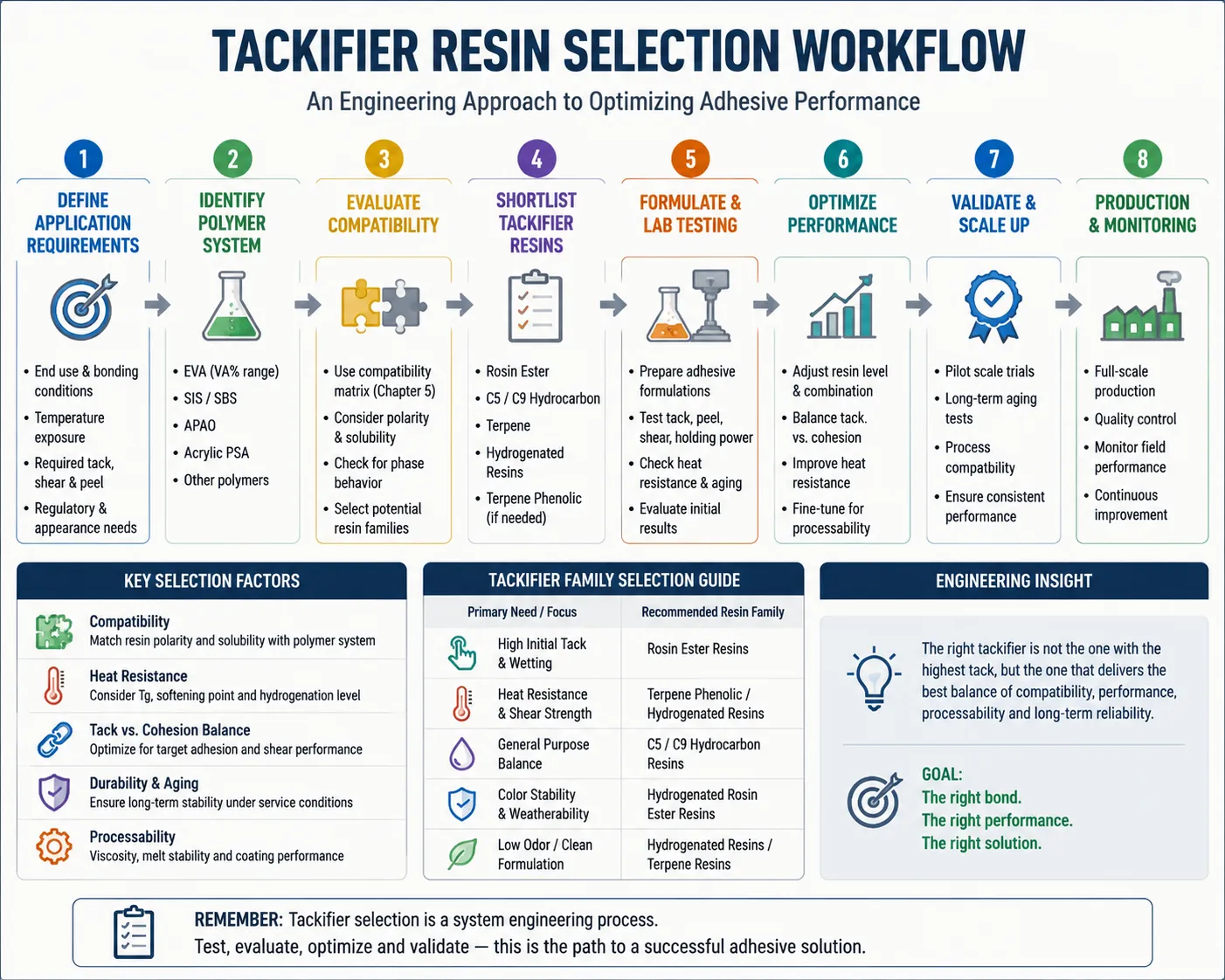
A reliable tackifier selection framework follows five steps:
Polymer Identification → Compatibility Evaluation → Performance Target → Resin Selection → Application Validation
Step 1: Identify the Base Polymer System
The first step in tackifier selection is understanding the adhesive polymer because the polymer determines the compatibility window and performance limitations.
Common adhesive polymer systems include:
| Polymer System | Main Characteristics | Typical Tackifier Direction |
|---|---|---|
| EVA | Polar hot melt adhesive polymer | Rosin ester, hydrogenated rosin ester |
| SIS/SBS | Elastomeric rubber adhesive system | C5 resin, terpene resin |
| APAO | Non-polar polyolefin system | Hydrocarbon resin |
| Acrylic PSA | High durability pressure-sensitive adhesive | Hydrogenated specialty tackifier |
Step 2: Evaluate Tackifier Compatibility
After identifying the polymer system, the next step is determining whether the tackifier can properly interact with the polymer matrix.
Compatibility evaluation should consider:
- Molecular polarity
- Solubility parameter relationship
- Phase stability
- Migration risk
- Long-term aging behavior
A resin with excellent individual properties may still fail if it creates an unstable adhesive structure.
Step 3: Define the Required Performance Balance
Different applications require different adhesive performance priorities.
| Application Requirement | Main Performance Focus | Tackifier Direction |
|---|---|---|
| Fast bonding | High tack and wetting | Lower viscosity, high mobility resin |
| Long-term holding | Cohesion and shear resistance | Higher Tg or reinforcing resin |
| High temperature service | Thermal stability | High softening point resin |
| Outdoor durability | Aging resistance | Hydrogenated tackifier |
| Low surface energy bonding | Interface interaction | Modified polar resin system |
Step 4: Select the Tackifier Family
Once the polymer and performance requirements are clear, engineers can select the appropriate resin family.
| Need | Preferred Tackifier Family |
|---|---|
| High initial tack | Rosin ester, C5 hydrocarbon resin |
| High shear strength | Terpene resin, higher Tg resin |
| High temperature resistance | Hydrogenated resin, high softening point resin |
| Non-polar polymer compatibility | Hydrocarbon resin |
| Long-term stability | Hydrogenated tackifier |
Step 5: Validate Through Application Testing
Laboratory compatibility is not enough. The final adhesive system must be tested under realistic operating conditions.
Typical validation tests include:
- Peel adhesion testing
- Loop tack testing
- Shear holding testing
- Heat aging testing
- Humidity aging testing
- Thermal cycling testing
Testing should reproduce the actual application environment whenever possible.
A Practical Tackifier Selection Decision Process
| Question | Engineering Decision |
|---|---|
| What polymer is being used? | Determine compatibility range |
| What failure needs to be prevented? | Define performance priority |
| What environment will the adhesive experience? | Select thermal and aging requirements |
| What resin family matches the system? | Choose candidate tackifiers |
| Does the formulation pass validation? | Confirm final selection |
Common Mistakes in Tackifier Selection
Choosing Based Only on Tack Value
High tack does not guarantee reliable bonding performance.
A formulation may have excellent initial adhesion but fail under heat, load, or aging conditions.
Ignoring the Polymer System
The same tackifier may perform well in one adhesive system and fail in another because compatibility determines final behavior.
Skipping Environmental Testing
Room-temperature testing alone cannot predict performance during:
- Heat exposure
- Humidity aging
- Mechanical loading
- Long-term service conditions
Final Engineering Principle
The best tackifier is not the resin with the highest adhesion, highest softening point, or lowest cost.
The best tackifier is the resin that creates the correct balance between:
Compatibility + Adhesion + Cohesion + Processing Performance + Long-Term Durability
Successful adhesive development is not a process of choosing a stronger resin. It is a process of designing the right relationship between the polymer, tackifier, application environment, and performance requirements.