
Quick Answer:
3M 4910 and tesa ACXplus 7065 are both high-performance acrylic foam tape solutions, but they are designed for different bonding priorities.
3M 4910 is mainly selected for applications where transparent appearance and invisible bonding are critical. Its clear acrylic foam construction makes it suitable for glass, transparent materials and appearance-sensitive assemblies.
tesa ACXplus 7065 is typically evaluated for demanding industrial bonding applications where reliable adhesion, stress relaxation and long-term assembly performance are the main considerations.
The correct choice depends on the complete application system, including substrate material, surface condition, environmental exposure, load requirements and customer qualification standards.
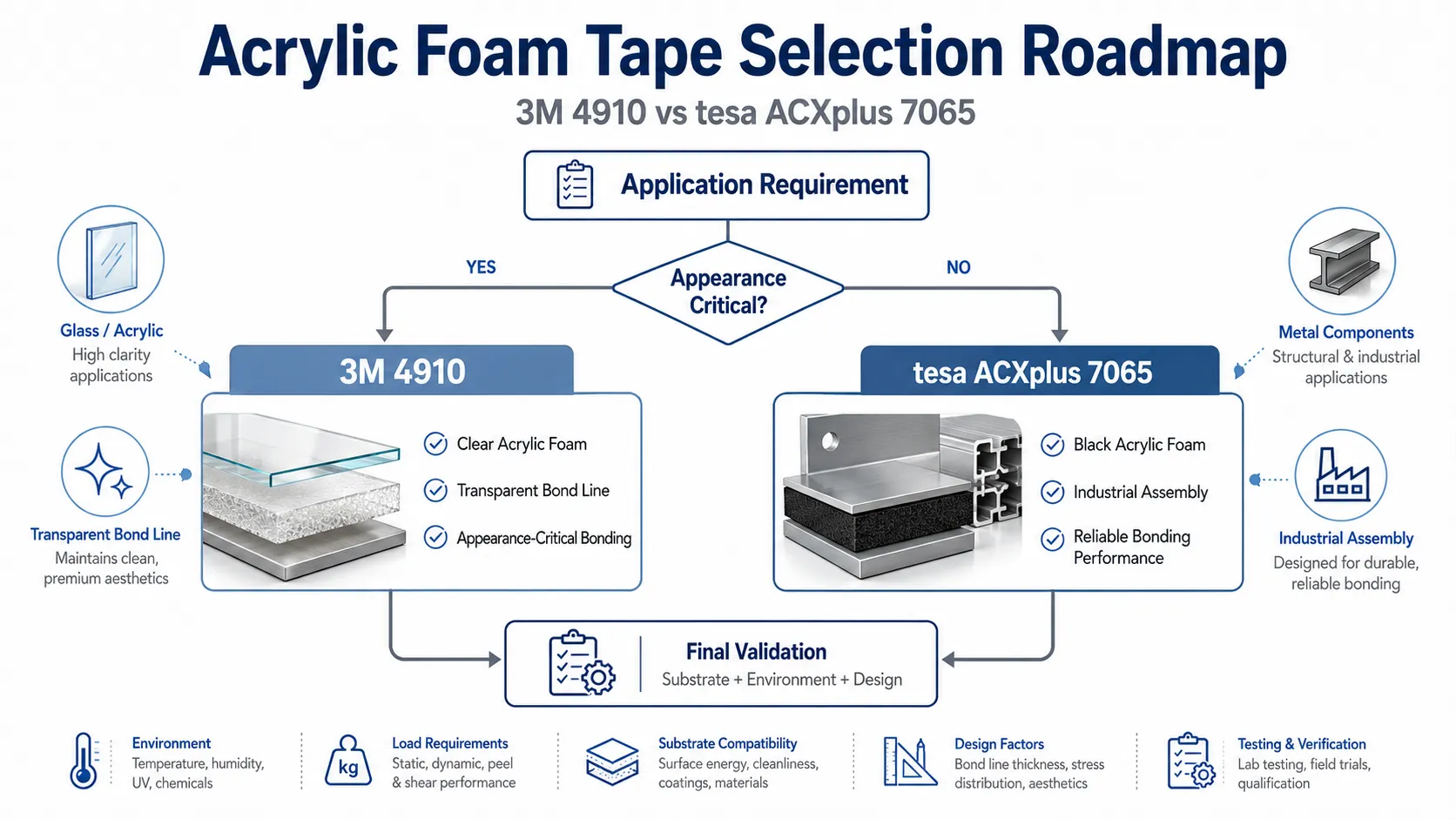
3M 4910 vs tesa ACXplus 7065: Simple Selection Rule
The easiest way to distinguish these two acrylic foam tape solutions is to identify the primary requirement of the application.
| Main Application Priority | Recommended Direction |
|---|---|
| Invisible bonding and clean appearance | 3M 4910 |
| Transparent materials where the adhesive line may be visible | 3M 4910 |
| Industrial assembly requiring reliable acrylic foam bonding | Evaluate tesa ACXplus 7065 |
| Automotive and industrial component applications | Select based on substrate, environment and validation requirements |
In simple terms:
3M 4910 focuses on appearance-critical transparent bonding, while tesa ACXplus 7065 focuses on reliable industrial acrylic foam bonding applications.
3M 4910 and tesa ACXplus 7065 Overview
Acrylic foam tapes are widely used in industrial bonding applications because they can provide strong adhesion, vibration resistance and stress distribution while reducing the need for mechanical fastening methods.
However, selecting an acrylic foam tape is not simply a matter of choosing the strongest adhesive. Different products are engineered around different application priorities.
3M 4910 and tesa ACXplus 7065 are a good example. Both belong to the acrylic foam tape category, but they solve different engineering problems.
3M 4910: Transparent Acrylic Foam Tape for Visible Bonding Applications
3M VHB Tape 4910 is a transparent acrylic foam tape designed for applications where strong bonding performance and clean appearance are both required.
Its clear acrylic foam construction provides an advantage when the adhesive layer may be visible after assembly or when maintaining the appearance of the final product is important.
Typical applications include:
- Glass panel bonding
- Transparent plastic assembly
- LED lighting components
- Decorative panels
- Appearance-critical industrial assemblies
The main selection advantage of 3M 4910 is not simply adhesive strength. It is the ability to provide reliable bonding while maintaining a nearly invisible bond line.
tesa ACXplus 7065: High-Performance Acrylic Foam Tape for Industrial Assembly
tesa ACXplus 7065 is a black acrylic foam tape designed for demanding industrial bonding applications where reliable adhesion and long-term performance are important.
Compared with transparent bonding solutions, tesa ACXplus 7065 is typically considered when industrial assembly requirements, substrate compatibility and mechanical reliability are higher priorities than invisible bonding.
Typical applications include:
- Automotive components
- Industrial profiles
- Decorative parts
- Metal and coated surface bonding
- General industrial assembly applications
The main selection advantage of tesa ACXplus 7065 is its focus on reliable industrial bonding performance under demanding application conditions.
Key Difference Between These Two Products
| Product | Main Design Priority |
|---|---|
| 3M 4910 | Transparent bonding where appearance and invisible bond lines are important |
| tesa ACXplus 7065 | Industrial bonding where reliable assembly performance is the main priority |
3M 4910 vs tesa ACXplus 7065: Technical Differences
Although 3M 4910 and tesa ACXplus 7065 are both acrylic foam tape solutions, their engineering characteristics are designed around different application priorities.
A common mistake in adhesive selection is comparing only one specification value, such as thickness or adhesion strength. In real applications, bonding reliability depends on the interaction between the adhesive system, substrate, joint design and operating environment.
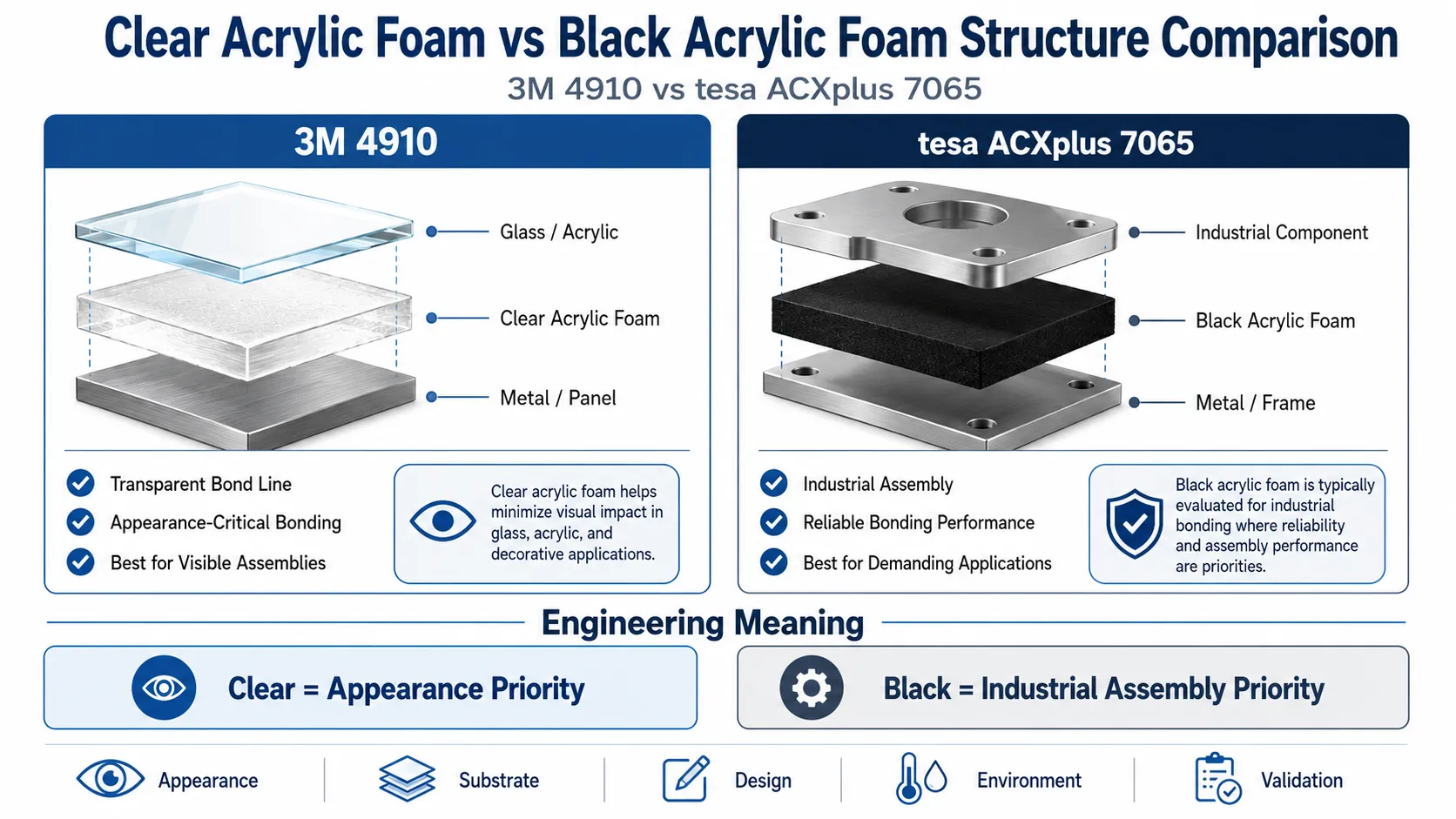
Acrylic Foam Structure and Adhesive Technology
Acrylic foam tapes use a viscoelastic foam structure that allows the adhesive layer to distribute stress, absorb movement and maintain bonding performance under dynamic conditions.
This combination of elasticity and adhesion is one of the main reasons acrylic foam tapes are widely used for industrial assembly applications.
| Feature | 3M 4910 | tesa ACXplus 7065 |
|---|---|---|
| Product Type | Transparent acrylic foam tape | Black acrylic foam tape |
| Color | Clear | Black |
| Thickness | 1.0 mm | 1.2 mm |
| Adhesive Technology | Acrylic adhesive | Tackified acrylic adhesive |
| Foam Structure | Solid acrylic foam | Foamed acrylic structure |
The difference between these two products is not simply a matter of performance level. They are optimized for different engineering requirements.
Clear Appearance vs Black Acrylic Foam: Why Color Matters
One of the most visible differences between 3M 4910 and tesa ACXplus 7065 is the foam color.
This difference is not only cosmetic. In many applications, adhesive appearance is part of the product design requirement.
Why Choose Transparent Acrylic Foam Tape?
3M 4910 uses a clear acrylic foam structure, making it suitable for applications where the adhesive layer may be visible after assembly.
Typical examples include:
- Glass bonding
- Transparent covers
- Acrylic panels
- Lighting components
- Decorative assemblies
In these applications, a black adhesive layer may affect the final appearance even if the bonding performance is acceptable.
Why Use Black Acrylic Foam Tape?
tesa ACXplus 7065 uses a black acrylic foam structure, which is commonly used in industrial assemblies where appearance requirements are different from transparent applications.
Black acrylic foam tapes are frequently selected for applications such as:
- Automotive decorative components
- Industrial profiles
- Metal assemblies
- Equipment components
The key point is that tape color often reflects the intended application environment rather than simply indicating better or worse performance.
Thickness Difference: Why 1.0 mm vs 1.2 mm Matters
The thickness difference between 3M 4910 and tesa ACXplus 7065 should not be interpreted as one product being automatically stronger than the other.
In acrylic foam tape applications, thickness influences several engineering factors:
- Gap Filling:
Thicker foam can accommodate larger surface irregularities. - Stress Relaxation:
Foam thickness affects how the adhesive system absorbs movement and stress. - Joint Design:
The correct thickness depends on the assembly structure and expected movement. - Appearance:
The bond line thickness can influence the final visual result.
Therefore, tape thickness should be selected according to the application design rather than treated as a simple performance ranking.
Substrate Compatibility and Surface Requirements
Substrate compatibility is one of the most important factors in acrylic foam tape selection.
Even high-performance adhesive tapes may fail if the surface condition is not suitable for bonding.
| Substrate | Selection Consideration |
|---|---|
| Glass | Appearance and long-term durability should be evaluated |
| Aluminum | Surface cleanliness and coating condition affect adhesion |
| Painted Metal | Paint compatibility and surface preparation are important |
| ABS / PC Plastics | Material compatibility and stress conditions should be considered |
| PP / PE Plastics | Low surface energy may require additional surface treatment |
Important surface preparation factors include:
- Cleaning method
- Surface contamination
- Surface energy
- Primer or treatment requirements
- Application pressure
Why Specification Numbers Alone Do Not Determine Performance
A higher specification value does not always guarantee better real-world bonding performance.
Many adhesive failures are caused not by insufficient tape performance, but by incorrect application conditions.
Common causes include:
- Incorrect substrate selection
- Insufficient surface preparation
- Improper joint design
- Unexpected environmental stress
- Incorrect application process
For this reason, professional adhesive selection should evaluate the complete bonding system rather than comparing isolated product specifications.
Why Brand Comparison Alone Is Not Enough
When engineers compare adhesive tapes, it is common to focus on brand names, product series or published specifications. However, successful bonding performance is rarely determined by the tape brand alone.
A more reliable approach is to evaluate the complete bonding system:
| Selection Factor | Why It Matters |
|---|---|
| Tape Technology | Different adhesive systems are designed for different bonding challenges |
| Substrate Material | Surface chemistry affects adhesive interaction and long-term performance |
| Surface Preparation | Cleaning and treatment directly influence adhesion reliability |
| Application Environment | Temperature, moisture, UV and mechanical stress affect durability |
| Joint Design | Bond area, stress direction and movement influence failure risk |

The Correct Way to Evaluate Acrylic Foam Tape
A common mistake is asking:
“Which tape is stronger, 3M 4910 or tesa ACXplus 7065?”
The more useful engineering question is:
“Which tape provides the most reliable performance for this specific application?”
For example, a transparent acrylic foam tape may be the correct choice for a glass bonding application because appearance is a critical requirement. However, the same product may not be the best solution for a demanding industrial assembly where substrate compatibility and long-term stress resistance are more important.
Acrylic Foam Tape Selection Is a System Decision
The final bonding result depends on the interaction between the tape and the complete application system.
| Application Question | Why It Matters |
|---|---|
| What materials are being bonded? | Different materials have different surface characteristics |
| Is the surface coated or treated? | Paints, coatings and finishes can change adhesion behavior |
| Will the joint experience movement? | Thermal expansion and vibration create additional stress |
| Is appearance important? | Visible bond lines may affect final product acceptance |
| What is the service environment? | Temperature, humidity and outdoor exposure affect durability |
Why the Same Tape Can Perform Differently in Different Applications
Two customers can use the same acrylic foam tape and achieve completely different results because the application conditions are different.
For example:
- A clean aluminum surface may provide excellent bonding performance.
- The same tape applied to a contaminated or poorly prepared surface may experience early failure.
- A large bonding area with balanced stress may perform well.
- A small bonding area with high peeling stress may fail even with a high-performance tape.
This is why adhesive tape selection should always consider the entire assembly design rather than the product specification alone.
Brand Qualification vs Engineering Optimization
In many industrial projects, brand qualification is an important factor. Some customers already have approved adhesive systems from suppliers such as 3M or tesa.
However, when developing a new product or evaluating alternatives, engineers should balance:
- Customer qualification requirements
- Technical performance
- Application reliability
- Supply chain stability
- Total project cost
The best adhesive solution is not always the most expensive or most recognized product. It is the solution that meets the technical requirements of the application with reliable long-term performance.
Engineering Principle
Tape selection should start with the application problem, not the product name.
3M 4910 and tesa ACXplus 7065 are both valuable acrylic foam tape solutions, but the correct choice depends on the engineering requirements behind the bonding application.
Application Comparison: Which Tape Fits Your Project?
The best acrylic foam tape is determined by the requirements of the final application, not only by the product specifications.
3M 4910 and tesa ACXplus 7065 can both provide reliable acrylic foam bonding performance, but their advantages become clearer when evaluated against different application scenarios.
Glass and Transparent Material Bonding
For glass and transparent materials, appearance is often one of the most important design requirements.
In these applications, the adhesive layer may remain visible after assembly. A transparent acrylic foam tape can provide an advantage by maintaining a cleaner final appearance.
3M 4910 is often evaluated for applications such as:
- Glass panel bonding
- Transparent covers
- Acrylic sheets
- Display components
- Lighting assemblies
| Requirement | Selection Consideration |
|---|---|
| Invisible bond line | Transparent acrylic foam tape provides an appearance advantage |
| Glass-to-metal bonding | Evaluate both adhesion performance and appearance requirements |
| Decorative transparent components | Bond appearance becomes a key selection factor |
For appearance-critical applications, the question is not only whether the tape can hold the materials together, but whether the final product meets visual expectations.
Automotive Exterior and Decorative Components
Automotive bonding applications usually require a balance between adhesion performance, environmental durability and appearance.
Components may experience:
- Temperature cycling
- UV exposure
- Vibration
- Mechanical stress
- Long-term outdoor conditions
tesa ACXplus 7065 may be evaluated for automotive and industrial component bonding applications where reliable assembly performance is required.
Typical examples include:
- Exterior decorative trims
- Automotive profiles
- Decorative components
- Industrial vehicle assemblies
| Automotive Requirement | Important Evaluation Factor |
|---|---|
| Exterior appearance | Color, bond line visibility and component design |
| Plastic component bonding | Material compatibility and surface preparation |
| Long-term outdoor use | Temperature, moisture and UV resistance |
| OEM projects | Qualification and validation requirements |
For automotive applications, no acrylic foam tape should be selected only because it is widely used in the industry. The final decision should be based on the actual component design and validation results.
LED Lighting and Decorative Equipment
LED and lighting applications often combine structural bonding requirements with appearance considerations.
The correct tape selection depends on whether the adhesive joint will be visible after assembly.
| Application | Selection Direction |
|---|---|
| Visible transparent lighting covers | Consider clear acrylic foam tape solutions such as 3M 4910 |
| Hidden internal assembly | Evaluate based on bonding requirements rather than appearance alone |
| Outdoor lighting equipment | Consider environmental exposure and durability requirements |
For lighting products, adhesive selection often involves balancing appearance, durability and manufacturing requirements.
Metal Panels and Industrial Assembly
Metal bonding applications are common in industrial manufacturing because acrylic foam tapes can provide strong bonding while reducing the need for mechanical fasteners.
Important evaluation factors include:
- Metal surface treatment
- Paint or coating condition
- Bond area design
- Static and dynamic loads
- Operating environment
Both 3M 4910 and tesa ACXplus 7065 may be evaluated for metal bonding applications depending on the project requirements.
| Metal Application | Main Consideration |
|---|---|
| Painted aluminum panels | Surface coating compatibility |
| Decorative metal parts | Appearance and long-term durability |
| Industrial equipment | Load requirements and environmental exposure |
Plastic Components and Difficult Substrates
Plastic bonding is often more challenging because different polymers have different surface characteristics.
Materials such as ABS, PC, PMMA, PP and PE may require different bonding considerations.
| Material | Main Selection Consideration |
|---|---|
| ABS | Generally suitable with proper surface preparation |
| PC | Consider stress conditions and material compatibility |
| PMMA | Consider appearance and stress-related risks |
| PP / PE | Low surface energy may require additional treatment |
For difficult substrates, adhesive selection should include evaluation of:
- Surface energy
- Cleaning process
- Primer requirements
- Environmental conditions
- Long-term durability
Application-Based Selection Summary
| Your Main Requirement | Recommended Evaluation Direction |
|---|---|
| Transparent and invisible bonding | 3M 4910 |
| Glass or appearance-critical applications | Evaluate clear acrylic foam tape solutions |
| Industrial assembly | Evaluate high-performance acrylic foam tape solutions such as tesa ACXplus 7065 |
| Automotive components | Select based on material, environment and validation requirements |
| Plastic bonding | Focus on substrate compatibility and surface preparation |
Common Failure Modes Caused by Incorrect Acrylic Foam Tape Selection
Many adhesive bonding failures are not caused by the tape itself. In many cases, the failure comes from selecting the wrong adhesive system for the application, incorrect surface preparation or insufficient understanding of the joint conditions.
Understanding common failure modes can help engineers avoid unnecessary replacement cycles and improve bonding reliability.
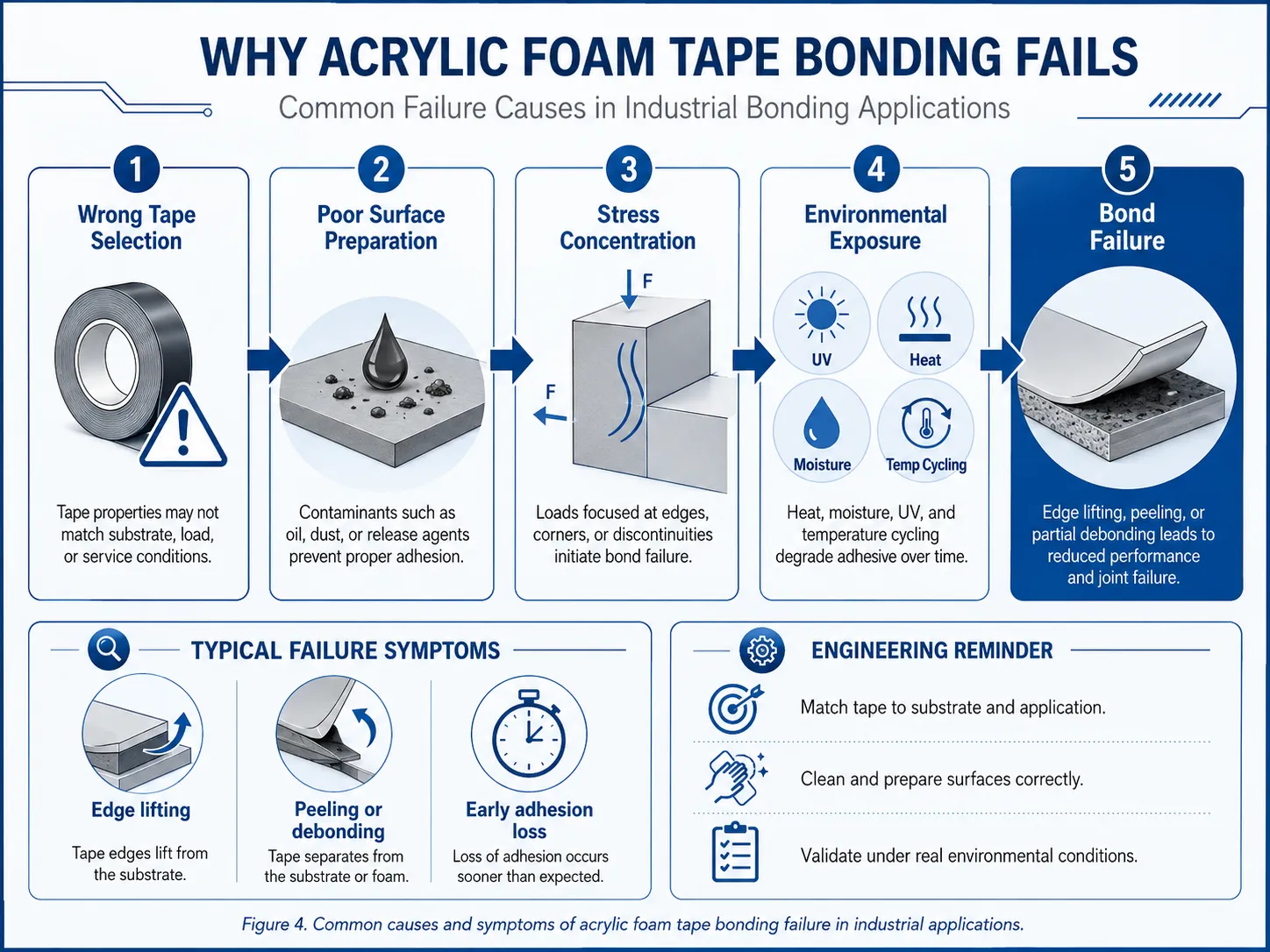
Failure Mode 1: Choosing a Tape Based Only on Thickness
One common mistake is assuming that a thicker acrylic foam tape will always provide better performance.
For example, a 1.2 mm tape is not automatically a better solution than a 1.0 mm tape. Thickness is only one part of the adhesive design and must be evaluated together with the application requirements.
Tape thickness affects:
- Gap Filling:
The ability to accommodate surface irregularities between bonded parts. - Stress Relaxation:
The ability of the foam structure to absorb movement and reduce stress concentration. - Joint Design:
The relationship between adhesive thickness, load direction and component movement. - Appearance:
The visual effect of the final bond line.
The correct thickness should be selected according to the assembly design, not simply based on a higher number.
Failure Mode 2: Comparing Adhesion Values Without Considering the Application
Another common mistake is selecting a tape only by published adhesion data.
Laboratory test values provide useful information, but they do not represent every real-world application condition.
A bonding failure may occur because of:
- Incorrect substrate selection
- Surface contamination
- Insufficient surface preparation
- Incorrect bonding area design
- Unexpected environmental stress
A tape with excellent laboratory performance may still fail if the application conditions are not suitable.
Failure Mode 3: Ignoring Surface Preparation
Surface preparation is one of the most important factors affecting acrylic foam tape performance.
Even a high-performance adhesive system requires proper contact between the adhesive and the substrate surface.
Common surface-related problems include:
| Problem | Possible Result |
|---|---|
| Oil or contamination on the surface | Reduced initial adhesion and early failure |
| Low surface energy material | Poor adhesive wet-out |
| Incorrect cleaning method | Unstable bonding performance |
| Surface coating inconsistency | Variable adhesion results |
For difficult substrates, engineers may need to evaluate additional processes such as specialized cleaning, primer application or other surface treatment methods.
Failure Mode 4: Direct Replacement Without Application Validation
One of the most common mistakes when replacing adhesive tapes is assuming that two acrylic foam tapes with similar specifications can be exchanged directly.
For example, replacing 3M 4910 with tesa ACXplus 7065 may appear reasonable because both products belong to the acrylic foam tape category. However, the final result depends on:
- Appearance requirements
- Substrate compatibility
- Bond design
- Environmental conditions
- Customer qualification requirements
A successful replacement should be verified through application testing before production approval.
Failure Mode 5: Designing the Joint Incorrectly
Adhesive tape performance is strongly influenced by the mechanical design of the bonded joint.
Acrylic foam tapes generally perform well under certain load conditions, but applications involving excessive peeling or concentrated stress may require additional design consideration.
Engineers should evaluate:
- Load direction
- Bond area size
- Component movement
- Vibration conditions
- Thermal expansion differences
A well-designed joint allows the adhesive system to perform as intended.
Engineering Lesson: Prevent Failure Before Choosing a Replacement
When an adhesive tape fails, the solution is not always choosing a stronger tape.
The better approach is identifying the actual failure cause:
| Observed Problem | Possible Cause |
|---|---|
| Edge lifting | Surface preparation, stress concentration or insufficient bonding area |
| Bond separation after temperature cycling | Thermal stress or unsuitable adhesive selection |
| Visible adhesive line | Incorrect tape appearance selection |
| Early adhesion loss | Substrate compatibility or contamination issue |
The most reliable adhesive solution is not necessarily the strongest tape available. It is the tape system that matches the material, design and operating environment of the application.
Can tesa ACXplus 7065 Replace 3M 4910?
A common question from purchasing teams and engineers is whether tesa ACXplus 7065 can directly replace 3M 4910.
The short answer is:
tesa ACXplus 7065 can be evaluated as an alternative acrylic foam tape solution in some applications, but it is not an identical replacement for 3M 4910.
Although both products belong to the acrylic foam tape category, they have different characteristics and are designed around different application priorities.
| Product | Main Selection Focus |
|---|---|
| 3M 4910 | Transparent bonding where appearance and invisible bond lines are important |
| tesa ACXplus 7065 | Industrial bonding applications where reliable assembly performance is a priority |
Why Direct Replacement Is Not Always Recommended
Replacing one acrylic foam tape with another is not simply a matter of matching product specifications.
The final bonding performance depends on the complete application system, including:
- Substrate material
- Surface condition
- Bonding area
- Joint design
- Temperature exposure
- Environmental conditions
- Customer qualification requirements
A tape that performs well in one application may not provide the same result in another application because the bonding conditions are different.
When tesa ACXplus 7065 May Be Considered as an Alternative
tesa ACXplus 7065 may be evaluated as an alternative when the application requires:
- High-performance acrylic foam bonding
- Industrial component assembly
- Long-term bonding reliability
- Stress relaxation capability
- Alternative supplier qualification
Typical evaluation scenarios include:
| Application Scenario | Alternative Evaluation Consideration |
|---|---|
| Industrial metal assembly | Evaluate adhesion, surface compatibility and environmental conditions |
| Automotive components | Confirm material compatibility and validation requirements |
| Decorative profiles | Consider appearance and long-term durability |
| Supplier replacement projects | Complete application testing before approval |
When 3M 4910 May Remain the Better Choice
3M 4910 may remain the preferred solution when transparent appearance and invisible bonding are essential requirements.
Examples include:
- Transparent glass assemblies
- Clear plastic components
- Visible decorative bonding areas
- Applications where existing 3M VHB qualification is required
In these applications, replacing a clear acrylic foam tape with a black acrylic foam tape may change the final appearance even if bonding performance is acceptable.
Replacement Evaluation Checklist
Before approving an acrylic foam tape replacement, engineers should evaluate the following areas:
| Evaluation Item | Purpose |
|---|---|
| Material compatibility | Confirm adhesive interaction with the bonded surfaces |
| Surface preparation | Ensure stable adhesive contact |
| Bond strength testing | Verify performance under actual conditions |
| Environmental testing | Evaluate temperature, moisture and aging resistance |
| Production validation | Confirm manufacturing consistency |
How to Evaluate a Tape Replacement Correctly
A successful replacement process should follow an engineering validation approach:
| Step | Evaluation Focus |
|---|---|
| Step 1 | Identify the original tape function and application requirements |
| Step 2 | Analyze substrate, surface condition and environmental exposure |
| Step 3 | Test the alternative tape under real application conditions |
| Step 4 | Approve the replacement after validation results meet requirements |
Engineering Conclusion
3M 4910 and tesa ACXplus 7065 should not be viewed as simple substitutes where one product is always better than the other.
They are different acrylic foam tape solutions designed for different application priorities.
The correct replacement decision should be based on application performance, not only product similarity.
How to Select Between 3M 4910 and tesa ACXplus 7065
Selecting the right acrylic foam tape should begin with the application requirement rather than the product name.
Both 3M 4910 and tesa ACXplus 7065 are high-performance bonding solutions, but the correct choice depends on the priority of the final application.
Choose 3M 4910 When Appearance Is a Critical Requirement
3M 4910 is often the preferred choice when the adhesive joint must remain visually clean after assembly.
The main selection advantages include:
- Transparent bond line
- Clean appearance after assembly
- Suitable for visible bonding areas
- Good fit for transparent materials
| Application Requirement | Why Consider 3M 4910 |
|---|---|
| Invisible bonding | Clear acrylic foam helps minimize visual impact |
| Glass or transparent components | Maintains product appearance |
| Decorative applications | Reduces visible adhesive lines |
| Existing 3M VHB qualification | May reduce qualification changes |
Choose tesa ACXplus 7065 When Industrial Reliability Is the Priority
tesa ACXplus 7065 is typically evaluated when the application requires reliable industrial bonding performance rather than invisible bonding.
The main selection considerations include:
- Industrial assembly requirements
- Long-term bonding reliability
- Stress relaxation capability
- Substrate and environmental challenges
| Application Requirement | Why Consider tesa ACXplus 7065 |
|---|---|
| Industrial component assembly | Designed for demanding bonding applications |
| Automotive components | Evaluate based on material and validation requirements |
| Metal and coated surfaces | Consider surface compatibility and preparation |
| Supplier alternative projects | Can be evaluated as another acrylic foam tape solution |
3M 4910 vs tesa ACXplus 7065 Selection Guide
| If Your Situation Is… | Recommended Direction |
|---|---|
| The adhesive line must be invisible | Consider 3M 4910 |
| You are bonding transparent materials | Evaluate clear acrylic foam tape solutions |
| You are assembling industrial components | Evaluate high-performance acrylic foam solutions such as tesa ACXplus 7065 |
| You are replacing an existing qualified tape | Perform application validation before approval |
| You need a lower technical risk solution | Follow existing qualification requirements |
Questions Engineers Should Ask Before Selecting a Tape
Before selecting an acrylic foam tape, engineers should define the actual requirements of the application.
| Question | Why It Matters |
|---|---|
| What materials are being bonded? | Different substrates require different adhesive compatibility |
| Will the bond line be visible? | Appearance requirements may determine tape selection |
| What environmental conditions exist? | Temperature, humidity and UV exposure affect durability |
| What type of load will the joint experience? | Peel, shear and dynamic stress influence performance |
| Does the application require customer approval? | Qualification requirements may limit replacement options |
Selection Principle: Match the Tape to the Failure Risk
The best acrylic foam tape is not necessarily the one with the highest specification value. It is the product that best reduces the risk of failure in the actual application.
For 3M 4910, the primary advantage is transparent bonding where appearance matters.
For tesa ACXplus 7065, the primary advantage is reliable industrial bonding performance in demanding assembly applications.
The final selection should always consider the complete application system, including materials, design, environment and validation requirements.
FAQ About 3M 4910 and tesa ACXplus 7065
Engineers and purchasing teams often have similar questions when comparing acrylic foam tape solutions. The following answers address common selection, replacement and application questions.
Is tesa ACXplus 7065 equivalent to 3M 4910?
No. tesa ACXplus 7065 and 3M 4910 are not identical products, although both belong to the acrylic foam tape category.
3M 4910 is mainly designed for transparent bonding applications where appearance and invisible bond lines are important. tesa ACXplus 7065 is a black acrylic foam tape typically evaluated for industrial bonding applications where reliable assembly performance is the main priority.
They may be considered alternative solutions in some applications, but replacement decisions should always be confirmed through application testing.
Which tape is stronger, 3M 4910 or tesa ACXplus 7065?
Neither product is universally stronger for every application.
Actual bonding performance depends on:
- Substrate material
- Surface preparation
- Bonding area
- Load conditions
- Environmental exposure
A tape with higher laboratory performance values does not always provide better results if the application conditions are not suitable.
Can tesa ACXplus 7065 replace 3M 4910?
tesa ACXplus 7065 can be evaluated as an alternative in some industrial bonding applications, but it should not be considered a direct one-to-one replacement.
The main difference is that 3M 4910 focuses on transparent appearance-critical bonding, while tesa ACXplus 7065 focuses on industrial acrylic foam bonding performance.
Before replacement, engineers should validate:
- Material compatibility
- Appearance requirements
- Environmental conditions
- Long-term bonding performance
Which tape is better for glass bonding?
For glass bonding where appearance is important, 3M 4910 is often considered because its transparent acrylic foam structure helps maintain a clean visual appearance.
However, the final selection should also consider glass type, surface condition, environmental exposure and required durability.
Which tape is better for automotive applications?
Both acrylic foam tape solutions may be evaluated for automotive-related applications, but the correct choice depends on the specific component requirements.
Important evaluation factors include:
- Plastic or metal substrate type
- Surface coating condition
- Temperature cycling
- UV exposure
- OEM qualification requirements
tesa ACXplus 7065 may be evaluated for many automotive and industrial component applications, but every project requires validation based on the actual design.
Can acrylic foam tape replace screws or mechanical fasteners?
In many applications, acrylic foam tapes can replace mechanical fastening methods by providing strong bonding, vibration damping and improved appearance.
However, replacement depends on:
- Load requirements
- Safety requirements
- Joint design
- Environmental conditions
Critical applications should always be validated before replacing mechanical fastening systems.
Why does acrylic foam tape fail after installation?
Adhesive failure is often caused by application conditions rather than the tape itself.
Common causes include:
- Insufficient surface cleaning
- Incorrect substrate selection
- Low surface energy materials
- Insufficient bonding pressure
- Incorrect joint design
- Environmental stress
Understanding the failure cause is usually more effective than simply selecting a stronger tape.
How should engineers test an acrylic foam tape replacement?
A proper replacement evaluation should test the tape under actual application conditions.
Recommended evaluation includes:
- Initial adhesion testing
- Long-term holding performance
- Temperature cycling
- Humidity exposure
- UV aging when required
- Failure mode analysis
Application validation provides a more reliable decision than comparing product specifications alone.
What Information Is Needed for Acrylic Foam Tape Selection?
Selecting the correct acrylic foam tape requires more than knowing the product name or comparing technical specifications.
For engineering evaluation, suppliers need to understand the complete application environment, including the bonded materials, surface conditions, load requirements and production process.
Providing accurate application information can significantly reduce trial-and-error testing and improve the success rate of adhesive selection.
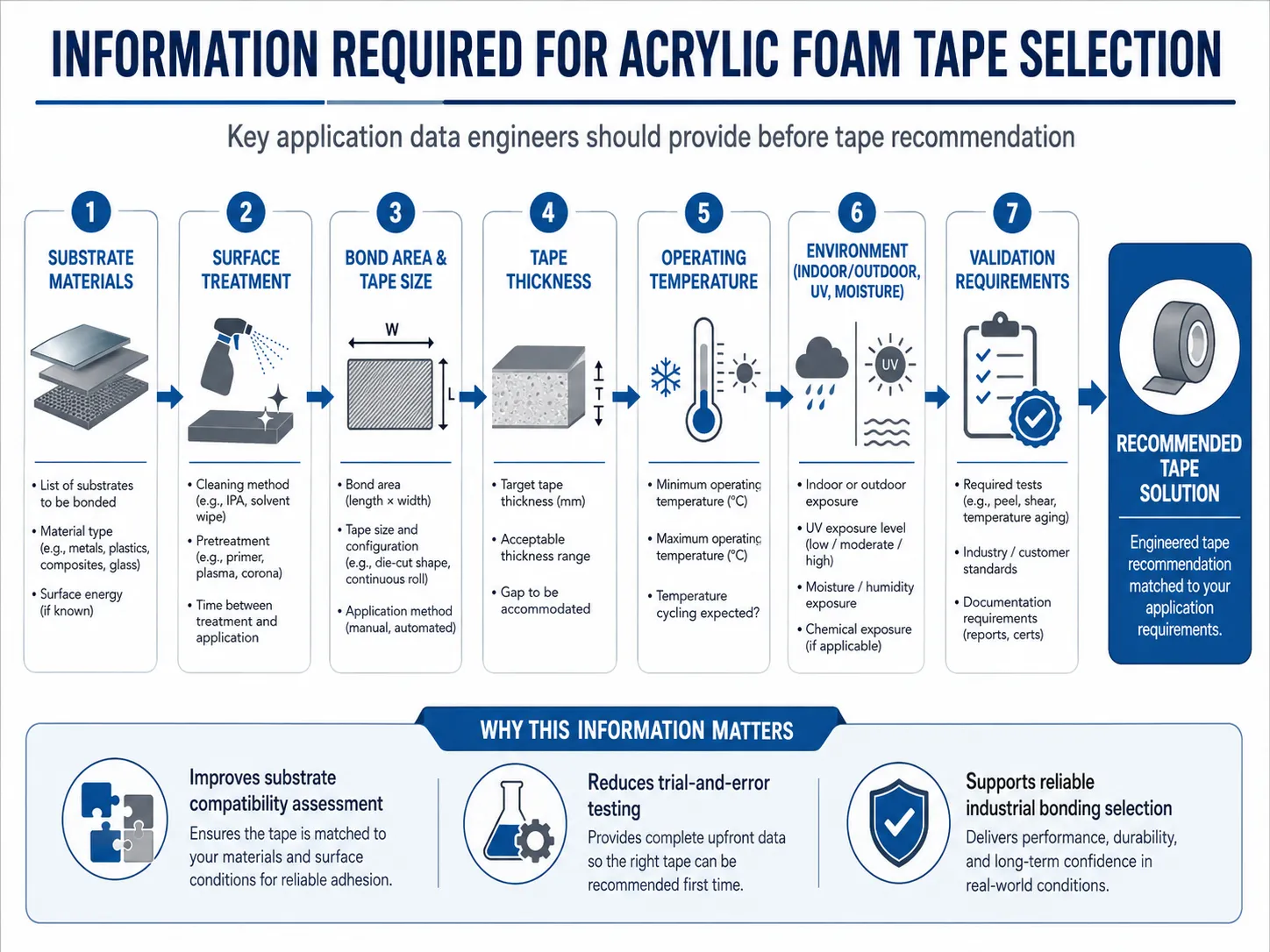
Key Information Engineers Should Provide Before Tape Selection
| Information Required | Why It Matters |
|---|---|
| Bonded materials | Different substrates have different surface characteristics and adhesive compatibility |
| Surface treatment or coating | Paints, coatings and finishes can significantly affect adhesion |
| Bonding area and tape size | Determines load distribution and required bonding performance |
| Required tape thickness | Affects gap filling, stress relaxation and joint design |
| Operating temperature range | Determines environmental resistance requirements |
| Indoor or outdoor application | Influences UV, moisture and aging considerations |
| Expected service life | Defines long-term reliability requirements |
| Production process | Application pressure, automation and assembly conditions affect performance |
Substrate Information Is the First Step
The bonded materials are one of the most important factors in adhesive selection.
Engineers should identify:
- Metal type
- Plastic type
- Glass or transparent materials
- Paint or coating system
- Surface treatment process
For example, bonding glass, painted aluminum and low surface energy plastics may require completely different evaluation approaches even when the same acrylic foam tape technology is considered.
Application Environment Affects Long-Term Performance
Acrylic foam tapes may perform differently depending on the operating environment.
Important environmental factors include:
- Temperature Cycling:
Repeated expansion and contraction can create stress within the bonded joint. - Humidity and Moisture:
Environmental exposure may affect certain substrates and interfaces. - UV Exposure:
Outdoor applications require consideration of long-term weather resistance. - Chemical Exposure:
Industrial environments may involve oils, cleaners or other chemicals.
Testing Before Mass Production
For industrial applications, adhesive selection should normally include validation testing before full production.
A typical evaluation process may include:
| Evaluation Stage | Purpose |
|---|---|
| Material review | Confirm substrate compatibility |
| Sample testing | Evaluate initial bonding performance |
| Environmental testing | Verify durability under expected conditions |
| Production trial | Confirm manufacturing process compatibility |
| Final approval | Ensure long-term application reliability |
How a Technical Supplier Can Support Tape Selection
A professional adhesive tape supplier should provide more than a product recommendation.
Technical support may include:
- Application analysis
- Material compatibility evaluation
- Sample recommendation
- Bonding test support
- OEM and customized tape solutions
The goal is not simply selecting a tape with high performance specifications, but developing a reliable bonding solution for the complete application.
Before Requesting a Tape Recommendation, Prepare These Details
For faster technical evaluation, customers should prepare:
- Photos or drawings of the application
- Bonded material information
- Current tape model if replacing an existing product
- Operating environment
- Required performance expectations
- Estimated usage volume
With complete application information, acrylic foam tape selection can be based on engineering requirements rather than trial and error.
Engineering Takeaway: Selecting the Right Acrylic Foam Tape
3M 4910 and tesa ACXplus 7065 are both high-performance acrylic foam tape solutions, but they are designed for different bonding priorities.
The correct selection is not about choosing the strongest tape or the most recognized brand. It is about selecting the adhesive system that best matches the application requirements.
The Main Difference Between 3M 4910 and tesa ACXplus 7065
| Application Priority | Recommended Direction |
|---|---|
| Transparent bonding and invisible bond lines | 3M 4910 |
| Glass, acrylic and appearance-critical applications | Consider clear acrylic foam tape solutions such as 3M 4910 |
| Industrial assembly requiring reliable bonding performance | Evaluate high-performance acrylic foam solutions such as tesa ACXplus 7065 |
| Automotive and industrial components | Select based on substrate, environment and validation requirements |
| Replacing an existing qualified tape | Perform application testing before production approval |
The Four Factors That Determine Bonding Success
A successful adhesive application depends on more than the tape itself. Engineers should evaluate four key factors before making a final selection.
- Substrate:
The bonded materials, coatings and surface characteristics determine adhesive compatibility. - Surface Preparation:
Cleaning methods, surface energy and treatment processes directly affect bonding reliability. - Application Design:
Bond area, stress direction, joint structure and movement influence long-term performance. - Environment:
Temperature cycling, moisture, UV exposure and chemical conditions affect durability.
Simple Decision Rule
The simplest way to distinguish these two products is:
| If Your Main Concern Is… | Consider… |
|---|---|
| Making the adhesive joint visually disappear | 3M 4910 |
| Building a reliable industrial assembly bond | tesa ACXplus 7065 |
However, product selection should always be confirmed through application evaluation. A technically suitable tape can still fail if the substrate, design or environment is not properly considered.
Final Engineering Recommendation
For applications where transparency and appearance are critical, 3M 4910 provides a clear advantage because of its transparent acrylic foam construction.
For industrial assembly applications where reliable bonding performance and long-term durability are the main priorities, tesa ACXplus 7065 should be evaluated as a high-performance acrylic foam tape solution.
Neither product is universally better. The best adhesive solution is the one that matches the specific requirements of the application.
Need Help Selecting an Acrylic Foam Tape Solution?
If you are evaluating 3M 4910 alternatives, tesa ACXplus 7065 solutions or other acrylic foam tape applications, the selection process should begin with understanding the complete bonding requirements.
Useful information for technical evaluation includes:
- Bonded materials and surface treatments
- Tape thickness and required bond area
- Operating temperature range
- Indoor or outdoor conditions
- Load requirements
- Expected service life
- Production requirements
With the correct application information, engineers can select an acrylic foam tape solution based on performance requirements rather than trial and error.