
Selecting the right acrylic foam tape is not simply about choosing the product with the highest adhesion strength.
The most reliable bonding solution is the one that matches the complete application system, including substrate characteristics, surface condition, joint design, environmental exposure and manufacturing requirements.
In industrial applications, bonding failures are rarely caused by insufficient adhesive strength alone. More often, failures occur when the adhesive technology does not match the substrate, stress conditions or production environment.
With 29 years of industrial adhesive tape manufacturing experience, KAWIN has supported OEM customers in automotive, electronics, appliances, medical and industrial applications through adhesive material solutions, custom converting services and application support.
This engineering guide explains how professionals evaluate acrylic foam tape selection, analyze common failure mechanisms and validate bonding solutions before mass production.
Quick Answer: How to Select the Right Acrylic Foam Tape
The best acrylic foam tape is not the product with the highest specification value. It is the construction that provides reliable long-term bonding performance under the actual application conditions.
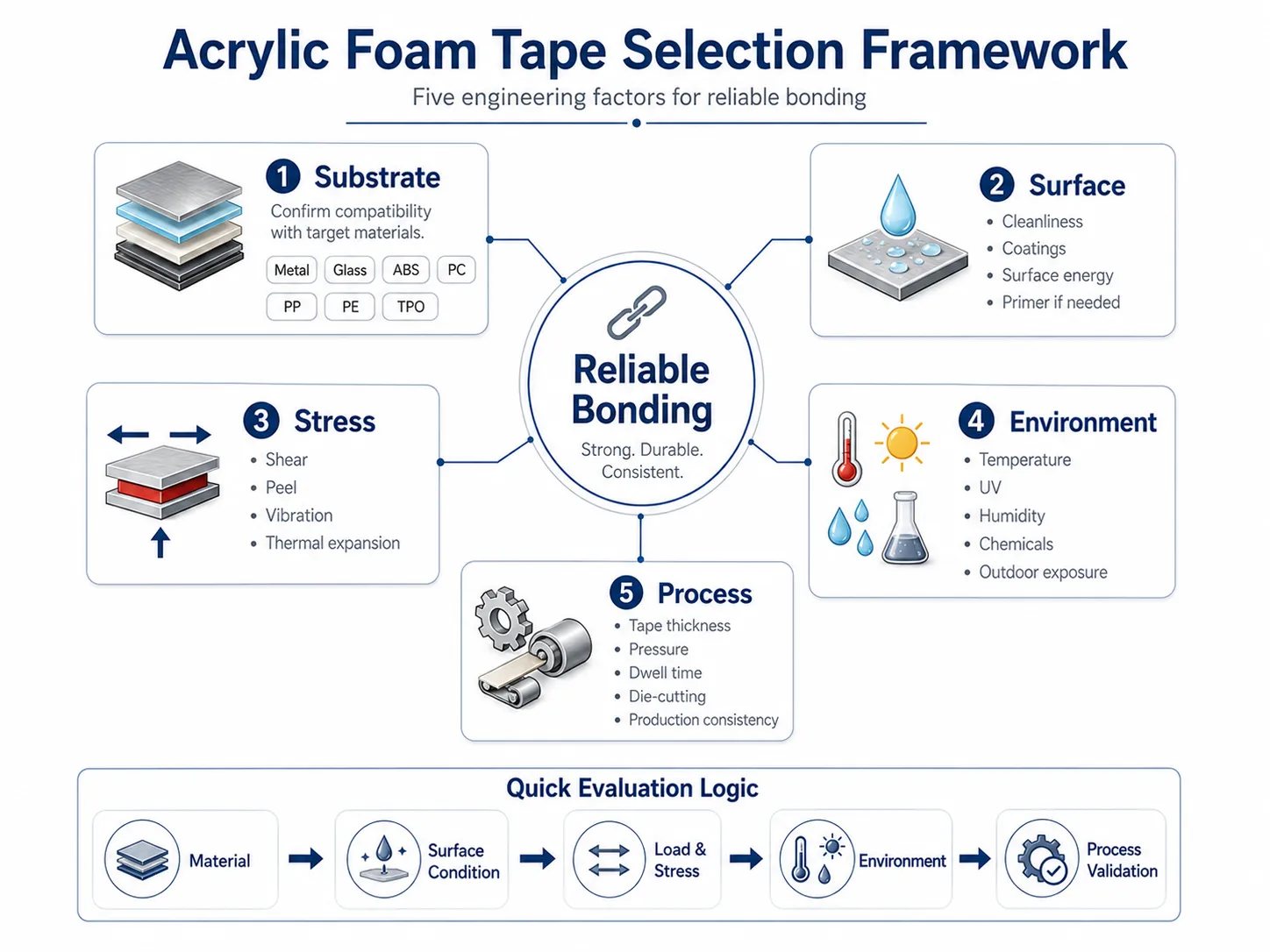
Acrylic Foam Tape Selection Formula
Reliable Bonding = Substrate Compatibility + Surface Preparation + Stress Management + Environmental Resistance + Manufacturing Control
Engineers should evaluate five core factors before approving an acrylic foam tape solution:
| Selection Factor | Engineering Question | Common Risk |
|---|---|---|
| Substrate Compatibility | Can the adhesive properly interact with the actual material surface? | Poor wet-out or interface failure |
| Surface Condition | Is the bonding surface clean, stable and suitable for adhesive application? | Contamination or inconsistent adhesion |
| Joint Design | Can the bonded structure handle shear, peel, vibration and movement? | Edge lifting or stress concentration |
| Environmental Exposure | Can the tape survive temperature, humidity, UV or chemical exposure? | Long-term aging failure |
| Manufacturing Process | Can production maintain consistent bonding quality? | Assembly variation |
Quick Decision Matrix for Acrylic Foam Tape Selection
| Application Condition | Engineering Direction |
|---|---|
| Metal / Glass Bonding | Evaluate standard acrylic foam tape constructions with proper surface preparation. |
| PP / PE / TPO Low Surface Energy Plastics | Evaluate LSE adhesive technology together with cleaning, primer or surface treatment requirements. |
| Vibration or Thermal Movement | Consider thicker acrylic foam structures with improved stress absorption capability. |
| Appearance-Critical Applications | Consider transparent acrylic foam constructions where visual appearance is important. |
| OEM Mass Production | Consider precision die-cut adhesive components for consistent assembly and production efficiency. |
Engineering Selection Principle
Acrylic foam tape selection should begin with understanding the application requirements, not searching for the strongest adhesive available.
The correct engineering approach is to match adhesive construction with substrate behavior, product design, environmental conditions and manufacturing needs.
Module 1: Why Industrial Acrylic Foam Tape Selection Fails: Common Engineering Mistakes Before Production
Acrylic foam tape is widely used in automotive, electronics, appliances, construction and industrial manufacturing because it can provide permanent bonding, vibration resistance and a clean appearance without traditional mechanical fasteners.
However, many adhesive bonding projects fail even when high-performance acrylic foam tapes are selected.
The reason is that adhesive performance is not determined by the tape alone. The final bonding result depends on the interaction between adhesive technology, substrate characteristics, product design, environmental conditions and manufacturing process.
Mistake 1: Selecting Tape by Adhesion Strength Alone
One of the most common mistakes in adhesive selection is choosing a tape only because it has a higher adhesion value.
A higher adhesion number does not automatically mean a more reliable bonding solution.
| Selection Method | Why It Creates Risk |
|---|---|
| Choosing the highest peel strength | High adhesion values do not guarantee compatibility with every substrate. |
| Selecting the strongest available tape | The adhesive may exceed the requirement while the actual failure occurs at another interface. |
| Comparing only one specification | Bonding performance depends on multiple factors, not a single number. |
Better Engineering Approach
Engineers should evaluate the complete bonding system:
- Substrate compatibility
- Surface condition
- Stress distribution
- Environmental exposure
- Production requirements
Mistake 2: Assuming the Same Tape Works on Every Material
Acrylic foam tape performance can vary significantly depending on the substrate being bonded.
A tape that performs well on aluminum or glass may not provide the same reliability on PP, PE or TPO plastics.
| Material Type | Typical Consideration |
|---|---|
| Metal | Usually provides a stable bonding surface, but contamination and coatings must be evaluated. |
| Glass | Generally favorable for bonding, but appearance and cleanliness are important. |
| ABS / PC | Requires evaluation of additives, molding conditions and thermal movement. |
| PP / PE / TPO | Requires special attention because of low surface energy characteristics. |
Mistake 3: Ignoring the Actual Bonding Surface
The theoretical material name does not always represent the real bonding surface.
For example, a component described as “metal” may actually contain:
- Paint coating
- Powder coating
- Surface treatment layer
- Manufacturing residue
The adhesive bonds with the actual surface layer, not the material name listed on the drawing.
| Surface Condition | Potential Impact |
|---|---|
| Oil or contamination | Reduces adhesive contact and weakens the interface. |
| Unstable coating | The coating may fail before the adhesive bond. |
| Surface variation | Creates inconsistent production results. |
Mistake 4: Evaluating Only Initial Bond Strength
A common misconception is that a strong initial bond means a reliable long-term bond.
Industrial products often experience:
- Temperature cycling
- Vibration
- Humidity
- UV exposure
- Continuous mechanical loading
These conditions can gradually affect bonding performance even when the initial assembly appears successful.
| Bonding Stage | Engineering Question |
|---|---|
| Initial Assembly | Does the adhesive properly contact and wet out the surface? |
| After Aging | Can the bond maintain performance under environmental stress? |
| Service Life | Can the complete system meet product lifetime requirements? |
Mistake 5: Replacing Tape Without Understanding the Failure Mechanism
When a bonding failure occurs, the first reaction is often to choose a stronger adhesive.
However, the actual cause may be:
- Incorrect surface preparation
- Substrate incompatibility
- Excessive peel stress
- Poor joint design
- Environmental mismatch
Replacing the tape without identifying the failure mechanism may only repeat the same problem with a different material.
Common Engineering Misunderstandings vs Reality
| Common Assumption | Engineering Reality |
|---|---|
| Higher adhesion means better performance | Compatibility and application conditions determine actual reliability. |
| The tape is the weakest point | Failure may occur at the substrate, coating or interface. |
| A successful laboratory test guarantees production success | Actual components and processes require validation. |
| A replacement tape only needs matching specifications | The complete bonding system must be evaluated. |
Engineering Principle
Most acrylic foam tape failures are not caused by a lack of adhesive strength. They are caused by a mismatch between the adhesive system and the application requirements.
Understanding the failure mechanism before selecting a material is the foundation of reliable industrial bonding.
Key Takeaway
Successful acrylic foam tape selection begins by avoiding common engineering mistakes.
The correct approach is not choosing the strongest tape, but selecting the right bonding system for the actual application.
Module 2: Five Engineering Factors for Reliable Acrylic Foam Tape Bonding
Reliable acrylic foam tape bonding requires evaluating the complete application system rather than selecting a tape based on a single specification value.
Professional adhesive selection considers the relationship between the adhesive construction, substrate, surface condition, mechanical stress, environment and manufacturing process.
The following five engineering factors provide a practical framework for evaluating acrylic foam tape applications before production.
Factor 1: Substrate Compatibility
The first step in adhesive selection is understanding what material is being bonded and how the adhesive interacts with that surface.
Different substrates create different bonding challenges because surface energy, chemical properties, coatings and manufacturing processes influence adhesive performance.
| Substrate | Engineering Consideration |
|---|---|
| Metal | Usually provides stable bonding conditions, but surface contamination, oxidation and coatings must be evaluated. |
| Glass | Generally provides a smooth bonding surface, but cleanliness and appearance requirements are important. |
| ABS / PC Engineering Plastics | Require evaluation of additives, molding conditions and thermal movement. |
| PP / PE / TPO Low Surface Energy Plastics | Require special attention because adhesive wet-out can be more challenging. |
Engineering Principle: The Adhesive Bonds to the Surface, Not the Material Name
A common mistake is evaluating only the material label.
For example, a component described as “metal” may actually have a paint coating or surface treatment layer. The adhesive interacts with the actual surface interface rather than the internal material.
Therefore, substrate evaluation should include:
- Actual surface condition
- Surface treatment
- Coating stability
- Manufacturing process history
Factor 2: Surface Condition and Preparation
Even a suitable adhesive may fail if the bonding surface is not properly prepared.
Industrial surfaces may contain:
- Oil residues
- Dust
- Mold release agents
- Processing contamination
- Unstable coatings
| Surface Problem | Potential Effect |
|---|---|
| Contamination | Reduces adhesive contact area and weakens the interface. |
| Low Surface Energy | Limits adhesive wet-out capability. |
| Surface Variation | Creates inconsistent bonding results. |
| Weak Coating Layer | Causes failure before the adhesive interface. |
Engineering Approach
Before changing adhesive materials, engineers should confirm whether the bonding surface itself is suitable.
Surface cleaning, treatment methods and process control often determine whether a bonding solution succeeds or fails.
Factor 3: Joint Design and Stress Management
Acrylic foam tape is designed to distribute stress and absorb movement, but the product design determines how forces are transferred through the bonded joint.
| Stress Type | Engineering Concern |
|---|---|
| Shear Stress | Continuous loading may create creep over time. |
| Peel Stress | Creates concentrated force at the bond edge. |
| Impact Loading | Requires sufficient energy absorption capability. |
| Vibration | Requires stable stress management during repeated movement. |
Why Joint Design Matters
A tape with excellent laboratory performance can still fail if the product design creates excessive stress concentration.
Engineers should consider:
- Bonding area size
- Load direction
- Component rigidity
- Movement between materials
- Edge stress concentration
Factor 4: Environmental Exposure
Industrial bonding applications often operate under conditions significantly different from standard laboratory testing.
Environmental factors that influence acrylic foam tape performance include:
| Environmental Condition | Potential Impact |
|---|---|
| Temperature Cycling | Different materials expand and contract at different rates, creating repeated stress. |
| High Temperature | May affect long-term creep resistance and adhesive stability. |
| Humidity | May influence long-term interface durability. |
| UV Exposure | Important for outdoor applications. |
| Chemical Exposure | May affect adhesive performance depending on the environment. |
Engineering Approach
The correct adhesive solution should be selected according to the actual service environment, not only laboratory specification values.
Factor 5: Manufacturing Process Control
A successful adhesive design must also work consistently during production.
Manufacturing conditions can significantly influence bonding reliability.
| Process Factor | Engineering Impact |
|---|---|
| Application Pressure | Insufficient pressure may reduce adhesive contact. |
| Application Temperature | Extreme temperatures may influence bonding development. |
| Assembly Accuracy | Incorrect placement may reduce effective bonding area. |
| Storage Conditions | Improper storage may affect material performance. |
The Complete Acrylic Foam Tape Evaluation Framework
| Engineering Area | Key Question |
|---|---|
| Material | Is the adhesive compatible with the substrate? |
| Surface | Can the adhesive properly contact the bonding surface? |
| Design | Can the joint handle expected forces? |
| Environment | Can the bond survive actual service conditions? |
| Process | Can manufacturing maintain consistent quality? |
Engineering Principle
Reliable acrylic foam tape bonding is achieved when adhesive technology is matched with the complete application system.
The most effective engineering approach is not selecting the strongest tape, but selecting the correct construction for the actual bonding conditions.
Key Takeaway
Acrylic foam tape selection should always consider five connected factors: substrate, surface, design, environment and process.
Evaluating these factors before production helps engineers reduce bonding risks and improve long-term reliability.
Module 3: Acrylic Foam Tape Construction, Specifications and Thickness Selection
Understanding acrylic foam tape construction is essential for selecting a reliable industrial bonding solution.
Unlike conventional double-sided adhesive tapes, acrylic foam tape is engineered as a complete bonding system. Its performance depends on the interaction between adhesive chemistry, foam structure, substrate characteristics and application conditions.
The purpose of acrylic foam tape is not only to create adhesion, but also to manage stress, absorb movement and maintain long-term bonding reliability.
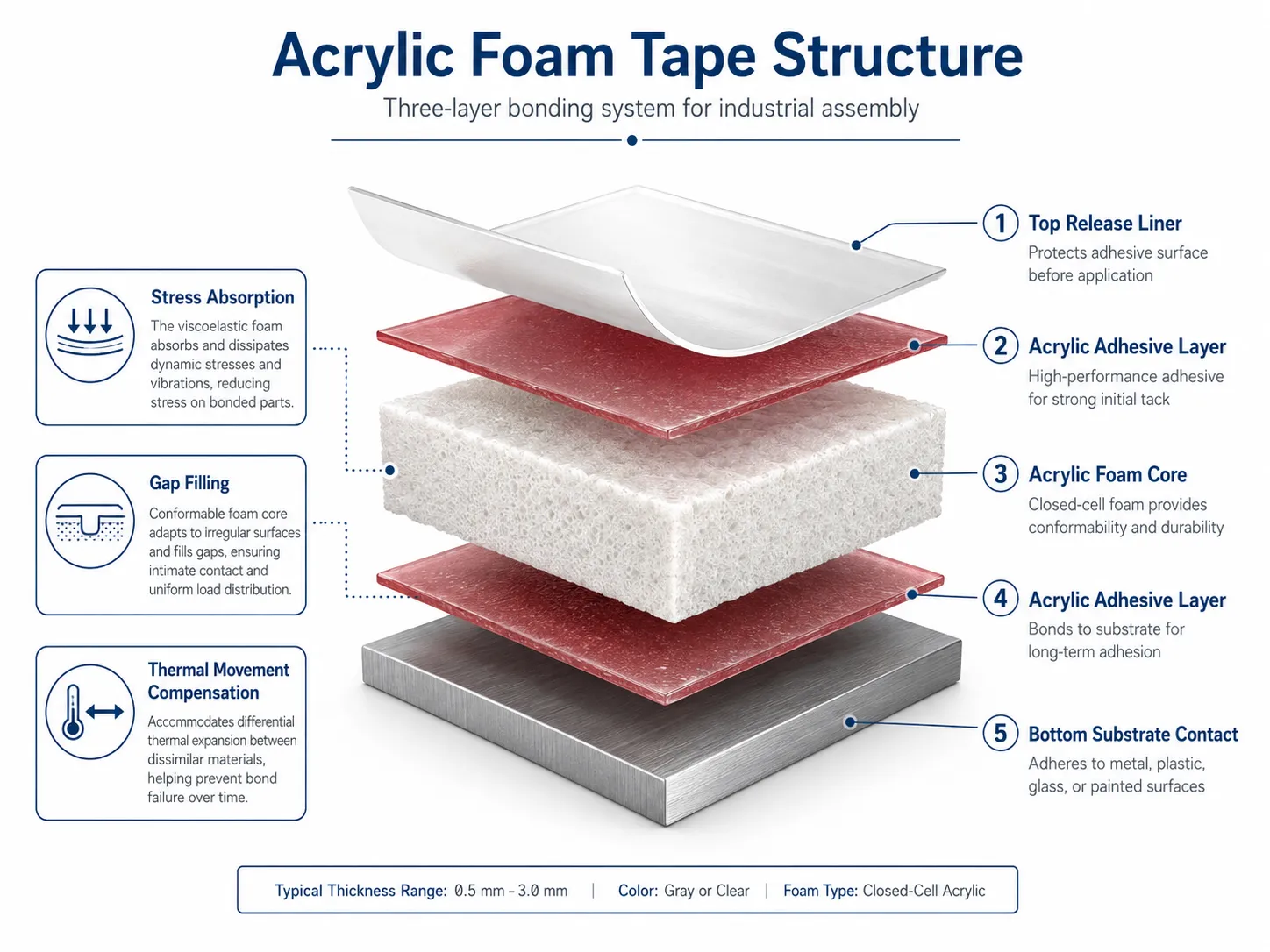
Acrylic Foam Tape Three-Layer Construction
A typical acrylic foam tape consists of a three-layer bonding structure:
| Layer | Engineering Function |
|---|---|
| Acrylic Adhesive Layer | Creates the bonding interface with the substrate and provides adhesion performance. |
| Acrylic Foam Core | Provides thickness, flexibility, stress absorption and movement compensation. |
| Acrylic Adhesive Layer | Allows bonding to the second substrate and supports different material combinations. |
A release liner is applied to protect the adhesive surface before application and support storage, handling and converting processes.
Why Acrylic Foam Core Is Important
The acrylic foam core is the key structural element that differentiates acrylic foam tape from standard double-sided adhesive tapes.
Because the foam core has viscoelastic characteristics, it can absorb stress caused by vibration, impact, thermal expansion and material movement.
| Foam Core Function | Engineering Benefit |
|---|---|
| Stress Relaxation | Reduces concentrated stress within the bonded joint. |
| Gap Filling | Improves contact on slightly uneven surfaces. |
| Movement Compensation | Helps accommodate different expansion rates between materials. |
| Vibration Absorption | Improves durability in dynamic applications. |
KAWIN Acrylic Foam Tape Construction
KAWIN acrylic foam tape uses a three-layer structure designed for industrial bonding applications.
The construction starts with an acrylic foam core, coated on both sides with acrylic pressure-sensitive adhesive. The tape is finished with a release film or liner to protect the adhesive before application.
| Component | Description |
|---|---|
| Acrylic Foam Core | Provides thickness, flexibility and stress management capability. |
| Double-Sided Acrylic Pressure Sensitive Adhesive | Provides bonding performance for different industrial substrates. |
| Release Film / Liner | Protects adhesive performance and supports precision converting. |
This construction enables acrylic foam tape solutions for applications requiring permanent attachment, vibration resistance, appearance improvement and customized adhesive components.
KAWIN Acrylic Foam Tape Technical Specifications
The following values represent typical KAWIN acrylic foam tape performance ranges. Actual performance may vary depending on adhesive grade, substrate, surface condition and testing method.
| Technical Parameter | Specification Range | Engineering Meaning |
|---|---|---|
| Thickness | 0.25 mm – 1.5 mm | Supports different bonding requirements including low-profile assembly, gap filling and stress compensation. |
| Color Options | Grey, Black, White, Transparent | Supports different product appearance requirements. |
| Adhesive Type | Acrylic Pressure Sensitive Adhesive | Provides durable industrial bonding performance. |
| 180° Peel Strength | 30 – 60 N/in | Provides reference information for peel adhesion evaluation. |
| Ring Initial Tack | 30 – 55 N/in | Indicates initial adhesive contact capability. |
| Retentivity | ≥24 hours | Provides reference information for holding performance under test conditions. |
| Long-Term Temperature Resistance | 120°C | Supports applications requiring continuous temperature exposure. |
| Short-Term Temperature Resistance | 160°C | Supports temporary higher temperature exposure conditions. |
Selecting the Right Acrylic Foam Tape Thickness
Thickness selection is one of the most important decisions in acrylic foam tape engineering.
A thicker tape does not automatically provide better performance. The correct thickness depends on the balance between stress absorption, bonding requirements, product design and environmental conditions.
| Thickness Range | Typical Application Consideration |
|---|---|
| 0.25 mm – 0.5 mm | Suitable for low-profile bonding where limited movement and minimal bond line thickness are required. |
| 0.6 mm – 1.0 mm | Provides a balance between adhesion, flexibility and stress management for general industrial assembly. |
| 1.1 mm – 1.5 mm | Suitable when greater movement compensation, gap filling or vibration resistance is required. |
Thickness Selection Based on Application Requirements
| Application Condition | Thickness Consideration |
|---|---|
| Rigid flat components | Thinner constructions may be sufficient when stress and movement are limited. |
| Uneven or textured surfaces | Thicker foam structures may improve surface contact. |
| Different material expansion rates | Additional foam thickness may help absorb movement stress. |
| Vibration applications | Flexible foam structures can improve stress distribution. |
Industry Benchmark: 3M VHB and tesa ACXplus Acrylic Foam Technologies
Recognized adhesive technologies such as 3M VHB and tesa ACXplus are widely referenced in industrial bonding applications.
These technologies provide useful engineering benchmarks for evaluating acrylic foam bonding performance.
| Technology Reference | Typical Engineering Consideration |
|---|---|
| 3M VHB 4910 | Transparent acrylic foam construction commonly evaluated for appearance-critical bonding applications. |
| 3M VHB 5952 | Acrylic foam technology commonly evaluated for demanding industrial bonding applications. |
| tesa ACXplus Series | Acrylic foam bonding technology used as an industrial assembly reference. |
| KAWIN Acrylic Foam Tape | Customized acrylic foam tape solutions with thickness selection, color options and converting support for OEM applications. |
Why Specification Comparison Alone Is Not Enough
Engineers should avoid selecting acrylic foam tape only by comparing one specification value.
A complete evaluation should consider:
- Adhesive technology
- Foam structure
- Substrate compatibility
- Joint design
- Environmental conditions
- Manufacturing requirements
Engineering Principle
Acrylic foam tape performance is created by the interaction between adhesive chemistry, foam structure, substrate characteristics and application conditions.
The best bonding solution is not necessarily the product with the highest specification value, but the construction that provides reliable performance throughout the product lifecycle.
Key Takeaway
Understanding acrylic foam tape construction and thickness selection allows engineers to choose bonding solutions based on application requirements rather than simple specification comparison.
Module 4: Substrate Compatibility and Surface Challenges in Acrylic Foam Tape Bonding
Substrate compatibility is one of the most important factors determining acrylic foam tape bonding reliability.
Acrylic foam tape performance is not determined only by adhesive strength. The adhesive must properly interact with the actual bonding surface, including the material properties, surface condition, coatings and manufacturing history.
A tape that performs well on one substrate may fail on another because different materials create different bonding challenges.
The Adhesive Bonds to the Surface Interface, Not Simply the Material
One of the most common misunderstandings in adhesive selection is evaluating only the material name.
In real industrial applications, the bonding interface may include:
- Base material
- Paint or coating layer
- Surface treatment layer
- Manufacturing residues
For example, bonding to “metal” does not always mean the adhesive is bonding directly to metal. In many applications, the actual interface is:
Adhesive → Coating Layer → Metal Substrate
If the coating layer is weaker than the adhesive bond, failure may occur within the coating system rather than the adhesive itself.
Substrate Compatibility Overview
| Substrate | Bonding Difficulty | Main Engineering Consideration |
|---|---|---|
| Aluminum / Steel | Low to Medium | Surface cleanliness, oxidation and coating condition. |
| Glass | Low | Surface cleanliness and appearance requirements. |
| ABS / PC | Medium | Additives, molding conditions and thermal movement. |
| PP / PE / TPO | High | Low surface energy and surface preparation requirements. |
Bonding Metal Substrates with Acrylic Foam Tape
Metal substrates are widely used in industrial bonding because they generally provide stable and durable bonding surfaces.
Common applications include:
- Automotive components
- Electronic housings
- Industrial equipment
- Appliance panels
However, successful bonding still depends on the actual surface condition.
| Metal Surface Condition | Engineering Consideration |
|---|---|
| Bare Metal | Usually provides a stable bonding interface when properly prepared. |
| Painted Metal | The adhesive interacts with the coating layer rather than the metal itself. |
| Powder Coating | Coating chemistry and adhesion stability should be evaluated. |
| Contaminated Surface | Oil, dust or residue can significantly reduce bonding performance. |
Engineering Consideration for Painted Metal
A strong adhesive bond cannot compensate for a weak coating system.
When bonding painted metal, engineers should evaluate:
- Coating adhesion strength
- Surface cleanliness
- Coating consistency
- Environmental aging resistance
Bonding Glass with Acrylic Foam Tape
Glass is generally considered a favorable substrate because it provides a smooth and stable bonding surface.
Common applications include:
- Display components
- Glass panels
- Electronic devices
- Decorative assemblies
| Glass Bonding Factor | Engineering Consideration |
|---|---|
| Surface Cleanliness | Fingerprints, dust and residues may reduce adhesive contact. |
| Appearance Requirement | Transparent acrylic foam constructions may be preferred. |
| Thermal Stress | Material movement should be considered in mixed-material assemblies. |
Bonding ABS and PC Engineering Plastics
ABS and polycarbonate (PC) are commonly used in automotive interiors, electronics and industrial equipment.
Although these materials are generally easier to bond than low surface energy plastics, application factors still require evaluation.
| Potential Challenge | Engineering Explanation |
|---|---|
| Molding Residues | Release agents and processing residues may reduce adhesive interaction. |
| Material Additives | Certain additives may influence long-term bonding stability. |
| Thermal Expansion | Plastic movement may create repeated stress. |
| Surface Variation | Production differences may affect bonding consistency. |
Bonding Low Surface Energy Plastics: PP, PE and TPO
Low surface energy plastics represent one of the most challenging categories in industrial adhesive bonding.
Common materials include:
- Polypropylene (PP)
- Polyethylene (PE)
- Thermoplastic Olefin (TPO)
These materials are widely used because they provide excellent durability, chemical resistance and lightweight performance.
However, their low surface energy characteristics make adhesive wet-out and surface interaction more difficult.
Why PP and TPO Bonding Is Challenging
| Challenge | Engineering Explanation |
|---|---|
| Low Surface Energy | Limits adhesive wet-out and surface interaction. |
| Mold Release Agents | Manufacturing residues may interfere with bonding. |
| Surface Variation | Different production conditions may create inconsistent results. |
| Thermal Movement | Plastic expansion and contraction can create repeated stress. |
Engineering Solutions for PP and TPO Bonding
Reliable bonding on low surface energy plastics requires evaluating the complete bonding system.
| Engineering Approach | Purpose |
|---|---|
| LSE Adhesive Technology | Improves bonding capability on difficult plastic surfaces. |
| Surface Cleaning | Removes contamination and improves consistency. |
| Primer Evaluation | May improve adhesion on challenging substrates. |
| Plasma / Corona Treatment | Can improve surface characteristics when required. |
| Application Validation | Confirms performance using actual components. |
Automotive TPO Bonding Considerations
TPO is widely used in automotive exterior components because of its impact resistance and durability.
However, bonding TPO components requires careful evaluation because automotive applications combine multiple challenges:
- Low surface energy plastics
- Temperature cycling
- Vibration
- Outdoor exposure
- Long service requirements
For automotive bonding applications, adhesive selection should be combined with surface preparation, component design and environmental validation.
Engineering Principle
Substrate compatibility is the foundation of adhesive reliability.
The correct acrylic foam tape solution begins with understanding the actual bonding surface, not simply choosing the strongest available adhesive.
Key Takeaway
Different substrates create different bonding challenges.
Reliable acrylic foam tape applications require matching adhesive technology, surface preparation and product design with the real material conditions.
Module 5: Acrylic Foam Tape Failure Analysis and Industrial Examples
Understanding adhesive failure mechanisms is one of the most important steps in developing reliable acrylic foam tape applications.
In industrial bonding, failures are rarely caused by a single factor. They usually result from the interaction between adhesive selection, substrate characteristics, surface preparation, joint design and environmental conditions.
A professional failure analysis process does not begin by selecting a stronger tape. It begins by identifying where the failure occurred and why the bonding system became unreliable.
The First Step: Identify Where the Failure Occurred
The location of failure provides important information about the bonding mechanism.
| Failure Location | Possible Interpretation |
|---|---|
| Adhesive separates from substrate | Possible interface problem, contamination or insufficient surface compatibility. |
| Foam layer tears internally | The adhesive bond may be stronger than the internal foam structure. |
| Coating separates from substrate | The coating layer may be the weakest part of the bonding system. |
| Edge lifting occurs first | Peel stress concentration or insufficient stress management. |

Failure Mode 1: Edge Lifting and Peel Failure
Edge lifting is one of the most common failure patterns in industrial acrylic foam tape applications.
The reason is that peel forces concentrate stress at the edge of the bonded area instead of distributing the load across the entire joint.
Typical Symptoms
- Tape edge begins separating after installation
- Bond appears acceptable initially but fails after use
- Failure starts from corners or exposed edges
Possible Root Causes
| Cause | Engineering Explanation |
|---|---|
| Insufficient Bonding Area | The joint cannot distribute the applied force effectively. |
| Excessive Peel Stress | Force concentration exceeds the capability of the bonded structure. |
| Incorrect Thickness Selection | The foam structure may not provide enough movement compensation. |
| Poor Product Design | The component geometry creates unnecessary stress concentration. |
Engineering Solutions
- Increase bonding area when possible
- Reduce peel loading through design optimization
- Select suitable foam thickness
- Validate the joint under actual loading conditions
Failure Mode 2: Adhesive Interface Failure
Interface failure occurs when the adhesive loses contact with the substrate surface.
This failure usually indicates that the adhesive and bonding surface were not properly matched.
Typical Symptoms
- Clean separation between adhesive and substrate
- Low initial adhesion
- Different results between materials that appear similar
Possible Root Causes
| Cause | Engineering Explanation |
|---|---|
| Surface Contamination | Oil, dust or residue prevents proper adhesive contact. |
| Low Surface Energy Material | Adhesive wet-out capability is insufficient. |
| Poor Surface Preparation | The bonding interface is unstable before application. |
| Coating Failure | The surface layer fails before the adhesive. |
Engineering Solutions
- Analyze the actual bonding surface
- Improve cleaning procedures
- Evaluate primer or surface treatment
- Test actual production components
Failure Mode 3: Cohesive Failure Inside Foam Structure
Cohesive failure occurs when separation happens inside the adhesive or foam structure rather than at the substrate interface.
This can indicate that the adhesive bond is stronger than the internal material strength.
| Condition | Engineering Consideration |
|---|---|
| High Mechanical Load | The selected construction may not match the stress requirement. |
| Continuous Shear Loading | Long-term creep resistance should be evaluated. |
| Dynamic Movement | Additional stress absorption capability may be required. |
Failure Mode 4: Temperature Cycling Failure
Many industrial bonding failures appear only after repeated temperature changes.
The reason is that different materials expand and contract at different rates, creating repeated stress within the bonded joint.
| Application Example | Potential Risk |
|---|---|
| Metal bonded to plastic | Different thermal expansion rates create interface stress. |
| Outdoor components | Daily temperature variation increases movement stress. |
| Automotive exterior parts | Heat, cold, vibration and weather exposure combine. |
Industrial Failure Analysis Examples
Example 1: Automotive TPO Component Bonding Failure
Failure Situation
| Item | Description |
|---|---|
| Application | Automotive exterior trim bonding. |
| Materials | TPO plastic bonded to painted metal. |
| Observed Problem | Edge lifting after environmental exposure. |
Engineering Analysis
The failure may initially appear to be caused by insufficient adhesive strength.
However, the actual bonding system may involve several challenges:
- Low surface energy characteristics of TPO
- Insufficient surface preparation
- Thermal expansion difference between materials
- Peel stress at component edges
Recommended Engineering Actions
- Evaluate LSE bonding requirements
- Review surface treatment process
- Optimize tape construction and thickness
- Perform environmental validation
Example 2: Painted Metal Panel Bonding Failure
Failure Situation
| Item | Description |
|---|---|
| Application | Industrial equipment or appliance panel assembly. |
| Material | Painted aluminum or steel. |
| Observed Problem | Bond separation or coating failure. |
Engineering Analysis
In painted metal applications, the adhesive does not directly bond to the metal substrate. The coating layer becomes part of the bonding system.
Possible causes include:
- Weak coating adhesion
- Surface contamination
- Coating variation
- Environmental aging
Recommended Engineering Actions
- Evaluate coating stability
- Control surface preparation
- Test actual production surfaces
- Validate under expected environmental conditions
Example 3: PC/ABS Housing Bonding Failure
Failure Situation
| Item | Description |
|---|---|
| Application | Electronic housing or industrial enclosure assembly. |
| Material | PC/ABS engineering plastic. |
| Observed Problem | Gradual adhesion reduction during long-term use. |
Engineering Analysis
Potential contributing factors include:
- Molding residues
- Material additives
- Thermal movement
- Joint stress concentration
Recommended Engineering Actions
- Evaluate actual molded surfaces
- Confirm cleaning process
- Select suitable adhesive construction
- Validate long-term performance
Common Lessons From Acrylic Foam Tape Failures
| Failure Pattern | Engineering Lesson |
|---|---|
| Initial success but later failure | Long-term environmental stress was underestimated. |
| Strong adhesive but weak bond | Interface compatibility was insufficient. |
| Failure at material boundary | The weakest layer was not always the adhesive. |
| Different results between projects | Application conditions were different. |
Engineering Principle
The purpose of failure analysis is not simply to find a stronger adhesive.
The purpose is to understand the bonding system, identify the weak point and prevent repeated failures through better engineering decisions.
Key Takeaway
Acrylic foam tape failures are usually system failures involving materials, interfaces, design and environmental conditions.
A structured failure analysis approach helps engineers develop more reliable bonding solutions and reduce production risk.
Module 6: Acrylic Foam Tape Alternatives and Custom Die-Cutting Solutions
In industrial manufacturing, companies often evaluate acrylic foam tape alternatives for different reasons, including supply chain flexibility, cost optimization, product development and manufacturing requirements.
However, selecting an alternative adhesive solution is not simply a process of finding a product with similar specifications.
A reliable alternative must provide comparable performance under the actual application conditions, including substrate compatibility, stress requirements, environmental exposure and production processes.
Why Companies Evaluate Acrylic Foam Tape Alternatives
| Reason | Engineering Objective |
|---|---|
| Supply Chain Flexibility | Reduce dependence on a single material source and improve supply security. |
| Cost Optimization | Maintain required performance while improving overall project economics. |
| Product Development | Find adhesive constructions better suited for new applications. |
| Performance Improvement | Solve existing bonding challenges or improve product reliability. |
| Manufacturing Requirements | Develop adhesive components suitable for production assembly. |
Why Specification Matching Alone Is Not Enough
One of the most common mistakes in adhesive replacement projects is comparing only visible specifications.
Important specifications may include:
- Thickness
- Adhesion values
- Temperature resistance
- Foam structure
- Color and appearance
However, successful replacement depends on how the adhesive system performs in the final application.
| Comparison Method | Potential Risk | Better Evaluation Approach |
|---|---|---|
| Matching thickness only | Different foam structures may behave differently under stress. | Evaluate stress absorption and joint requirements. |
| Matching adhesion value only | Adhesion depends on substrate and surface conditions. | Test actual bonded materials. |
| Matching temperature rating only | Real applications include movement, vibration and aging. | Validate under realistic conditions. |
| Selecting the lowest-cost option | Material savings may create higher failure costs. | Evaluate total application reliability. |
Engineering Framework for Acrylic Foam Tape Alternative Evaluation
| Evaluation Area | Engineering Question |
|---|---|
| Substrate Compatibility | Can the alternative bond reliably with the actual materials? |
| Adhesive Performance | Does the adhesive technology meet application requirements? |
| Foam Construction | Does the structure provide sufficient stress management? |
| Environmental Resistance | Can the material survive expected service conditions? |
| Validation Results | Has performance been confirmed on actual components? |
Evaluating 3M VHB Alternatives
3M VHB is widely recognized as an industry reference for acrylic foam bonding technology.
When evaluating a 3M VHB alternative, engineers should focus on application performance rather than simple model-to-model replacement.
| Evaluation Factor | Engineering Consideration |
|---|---|
| Substrate Combination | The same adhesive construction may perform differently on different materials. |
| Bonding Stress | Peel, shear, vibration and movement influence reliability. |
| Environmental Conditions | Temperature, humidity and UV exposure affect long-term performance. |
| Validation Method | Actual production components should be tested before approval. |
Industry Reference Comparison: Acrylic Foam Technologies
| Technology Reference | Engineering Role |
|---|---|
| 3M VHB Series | Provides industry reference standards for acrylic foam bonding applications. |
| tesa ACXplus Series | Provides another recognized acrylic foam bonding technology reference. |
| KAWIN Acrylic Foam Tape | Provides customized industrial adhesive solutions with thickness selection and converting support. |
Evaluating tesa ACXplus Alternatives
tesa ACXplus represents another established acrylic foam bonding technology used in industrial assembly applications.
Similar to other adhesive technologies, successful evaluation depends on application requirements rather than product name comparison alone.
Engineers should consider:
- Adhesive interaction with the substrate
- Foam flexibility and stress absorption
- Environmental durability
- Production compatibility
Custom Die-Cutting Solutions for Acrylic Foam Tape Applications
Many OEM customers do not use adhesive tape only as a standard roll product.
Industrial manufacturing often requires adhesive components that match specific product geometries, assembly processes and production requirements.
Custom converting transforms adhesive materials into production-ready components that improve consistency, efficiency and assembly reliability.
From Adhesive Material to Production Component
| Customer Requirement | Engineering Benefit |
|---|---|
| Custom Shape | Creates adhesive parts matching product geometry. |
| High Production Volume | Improves application consistency compared with manual cutting. |
| Limited Assembly Space | Provides accurate adhesive placement. |
| Multi-Layer Structure | Supports complex adhesive component designs. |
KAWIN Custom Converting Capabilities
| Process | Application Benefit |
|---|---|
| Die Cutting | Produces custom adhesive shapes based on customer drawings. |
| Kiss Cutting | Allows easy liner removal while maintaining adhesive part integrity. |
| Roll Slitting | Provides customized widths for production requirements. |
| Laminating | Combines adhesive materials with functional layers. |
| Multi-Layer Adhesive Components | Supports complex industrial assembly requirements. |
Supporting Customer-Specified Adhesive Materials
Some OEM customers already have approved adhesive materials based on internal specifications or product requirements.
KAWIN supports converting projects using customer-specified industrial adhesive materials, including projects requiring processing of recognized adhesive platforms such as 3M VHB.
The objective is not to replace customer specifications, but to provide reliable converting and manufacturing support.
Typical Industries Using Custom Adhesive Components
| Industry | Typical Applications |
|---|---|
| Automotive | Exterior trims, emblems, interior components and electronic assemblies. |
| Electronics | Housing assembly, displays, sensors and internal components. |
| Appliances | Panels, decorative components and structural attachment. |
| Industrial Equipment | Labels, insulation components and assembly solutions. |
Engineering Principle
The value of an industrial adhesive solution is not only the tape material itself, but also how effectively it integrates into the customer’s manufacturing process.
A complete adhesive solution combines material selection, engineering evaluation and production capability.
Key Takeaway
Acrylic foam tape alternatives should be evaluated through engineering validation rather than simple specification matching.
For OEM applications, custom converting transforms adhesive materials into reliable production components that improve assembly efficiency and consistency.
Module 7: Acrylic Foam Tape Validation Process Before Mass Production
Selecting an acrylic foam tape solution is only the beginning of the engineering process.
Before mass production, engineers should validate the complete bonding system using actual materials, production conditions and expected service environments.
A proper validation process helps prevent unexpected failures, production interruptions and costly redesigns.
Why Validation Is Critical for Industrial Bonding
Acrylic foam tape performance depends on multiple connected factors:
- Adhesive construction
- Substrate compatibility
- Surface preparation
- Joint design
- Application process
- Environmental conditions
Technical data sheets provide important reference information, but they cannot fully predict performance in every real application.
The final bonding result must be confirmed through application-specific validation.
The Five Stages of Acrylic Foam Tape Validation
| Validation Stage | Engineering Objective |
|---|---|
| 1. Application Review | Understand materials, design requirements and operating conditions. |
| 2. Prototype Testing | Evaluate bonding performance using actual components. |
| 3. Environmental Validation | Confirm durability under expected service conditions. |
| 4. Production Trial | Verify manufacturing consistency. |
| 5. Final Approval | Confirm suitability for mass production. |
Stage 1: Application Review
Before selecting or approving an acrylic foam tape solution, engineers should define the complete application requirements.
| Information Required | Why It Matters |
|---|---|
| Substrate Materials | Determines adhesive compatibility. |
| Surface Condition | Determines whether proper adhesive contact can be achieved. |
| Component Design | Determines stress distribution and load conditions. |
| Operating Environment | Defines temperature, humidity, UV and chemical exposure requirements. |
| Service Life Requirement | Defines long-term reliability expectations. |
Stage 2: Prototype Bonding Evaluation
Prototype testing should use actual production materials whenever possible.
Testing on laboratory panels can provide useful information, but real components reveal application-specific challenges.
| Prototype Evaluation | Purpose |
|---|---|
| Bond Appearance | Check alignment, bond line and visual requirements. |
| Initial Adhesion | Confirm basic bonding performance. |
| Handling Strength | Evaluate whether assemblies can move through production. |
| Application Process | Confirm repeatability during assembly. |
Stage 3: Environmental Validation
Industrial products often experience conditions beyond standard room-temperature testing.
Environmental validation helps evaluate whether the bonding system can maintain performance during service life.
| Test Condition | Purpose |
|---|---|
| Temperature Cycling | Evaluates stress caused by different thermal expansion rates. |
| High Temperature Exposure | Evaluates long-term adhesive stability. |
| Humidity Testing | Evaluates moisture resistance. |
| UV Exposure | Evaluates outdoor durability. |
| Chemical Exposure | Evaluates resistance to oils, cleaners and industrial chemicals. |
Stage 4: Production Trial Validation
A bonding solution that works in the laboratory must also work consistently during manufacturing.
| Production Factor | Potential Risk |
|---|---|
| Application Pressure | Insufficient pressure may reduce adhesive contact. |
| Surface Preparation Process | Process variation may create inconsistent results. |
| Assembly Accuracy | Incorrect placement may reduce effective bonding area. |
| Storage Conditions | Improper storage may influence material performance. |
Acrylic Foam Tape Engineering Checklist
The following checklist provides a practical review framework before approving an acrylic foam tape solution.
| Evaluation Area | Engineering Question |
|---|---|
| Application Function | Is the tape required for bonding, mounting, sealing or vibration control? |
| Substrate | What materials are being bonded? |
| Surface Condition | Is the surface clean, stable and suitable for bonding? |
| Surface Treatment | Is cleaning, primer or treatment required? |
| Bonding Area | Is the available area sufficient for expected loads? |
| Stress Type | Will the joint experience shear, peel, vibration or impact? |
| Temperature | What operating temperature range is required? |
| Environment | Will the product experience humidity, UV or chemical exposure? |
| Thickness Selection | Does the foam thickness provide enough stress management? |
| Production Process | Can the application process maintain consistent quality? |
| Validation Testing | Has the complete system been tested before mass production? |
Engineering Decision Workflow
| Step | Engineering Question |
|---|---|
| Step 1: Define Application | What function must the adhesive solution provide? |
| Step 2: Identify Materials | Are the substrates compatible with acrylic foam tape technology? |
| Step 3: Analyze Stress | What forces will act on the bonded joint? |
| Step 4: Select Construction | What thickness and adhesive structure are required? |
| Step 5: Validate Performance | Does the solution work under realistic conditions? |
Working With an Industrial Adhesive Tape Manufacturer
For complex bonding applications, cooperation between customers and adhesive manufacturers can improve development efficiency and reduce risk.
A professional supplier can support:
- Material recommendation
- Application evaluation
- Prototype samples
- Custom converting
- Production optimization
KAWIN supports OEM customers from adhesive material evaluation to customized adhesive component manufacturing, helping develop reliable bonding solutions for industrial applications.
Engineering Principle
A successful acrylic foam tape solution is approved not because the tape has the highest specification, but because the complete bonding system has been validated.
Reliable bonding requires the right combination of material selection, engineering design, manufacturing control and application testing.
Key Takeaway
Validation before mass production is one of the most important steps in preventing acrylic foam tape failures.
A systematic engineering process allows manufacturers to reduce risk, improve reliability and achieve consistent production performance.
Frequently Asked Questions About Acrylic Foam Tape Selection and Applications
How do I select the right acrylic foam tape for an industrial application?
The right acrylic foam tape should be selected based on the complete bonding system rather than a single specification value.
Engineers should evaluate:
- Substrate compatibility
- Surface condition
- Bonding stress
- Environmental exposure
- Manufacturing requirements
The best adhesive solution is the one that provides reliable long-term performance under actual application conditions.
Why does acrylic foam tape fail even when the adhesive strength is high?
High adhesive strength alone does not guarantee bonding reliability.
Common causes of failure include:
- Poor substrate compatibility
- Surface contamination
- Low surface energy materials
- Excessive peel stress
- Insufficient environmental validation
Adhesive failure analysis should identify the weak point in the complete bonding system before changing materials.
What is the difference between acrylic foam tape and regular double-sided tape?
The main difference is the acrylic foam core structure.
Acrylic foam tape uses a viscoelastic foam layer between adhesive layers, which provides:
- Stress absorption
- Gap filling capability
- Movement compensation
- Improved vibration resistance
This makes acrylic foam tape suitable for demanding industrial bonding applications where standard double-sided tapes may not provide sufficient durability.
Can acrylic foam tape bond PP, PE and TPO plastics?
Yes, but low surface energy plastics such as PP, PE and TPO require careful evaluation.
Successful bonding usually requires consideration of:
- LSE adhesive technology
- Surface cleaning
- Primer requirements
- Surface treatment methods
- Application validation
Because automotive materials such as TPO often experience vibration, temperature cycling and outdoor exposure, validation is especially important.
How do I choose the correct acrylic foam tape thickness?
Thickness selection depends on application requirements rather than simply choosing a thicker tape.
| Application Requirement | Thickness Consideration |
|---|---|
| Low-profile assembly | Thinner constructions may be suitable when movement is limited. |
| General industrial bonding | Medium thickness often provides a balance between strength and flexibility. |
| Vibration or thermal movement | Thicker foam structures may provide better stress absorption. |
How should I evaluate a 3M VHB alternative?
A 3M VHB alternative should be evaluated based on application performance rather than product name or specification matching alone.
Important evaluation factors include:
- Substrate compatibility
- Foam construction
- Thickness requirements
- Environmental resistance
- Actual component testing
3M VHB products can be used as industry reference points, but successful replacement requires validation under real application conditions.
How should I evaluate a tesa ACXplus alternative?
A tesa ACXplus alternative should be evaluated through the same engineering principles used for any acrylic foam bonding solution.
The evaluation should consider:
- Adhesive interaction with the substrate
- Stress management capability
- Environmental durability
- Production compatibility
The final decision should be based on application performance rather than specifications alone.
Can KAWIN provide custom die-cut acrylic foam tape parts?
Yes.
KAWIN provides custom converting solutions for industrial adhesive applications, including:
- Die cutting
- Kiss cutting
- Roll slitting
- Laminating
- Customized adhesive components
Custom converting allows OEM customers to integrate adhesive materials directly into production processes with improved consistency and efficiency.
Can KAWIN process customer-specified adhesive materials?
Yes.
Some OEM customers already have approved adhesive materials according to their internal specifications.
KAWIN supports converting projects using customer-specified industrial adhesive materials, including applications involving recognized adhesive platforms such as 3M VHB.
The goal is to provide reliable processing and manufacturing support while maintaining customer material requirements.
What information should I provide when requesting an acrylic foam tape recommendation?
To recommend a suitable acrylic foam tape solution, engineers should provide:
- Substrate materials
- Component drawings or bonding area information
- Environmental conditions
- Load requirements
- Production process requirements
- Required service life
This information allows adhesive selection to be based on the real application instead of general specifications.
Engineering Conclusion: Acrylic Foam Tape Selection Is a System Engineering Process
Acrylic foam tape selection is not simply a comparison of adhesive strength, thickness or temperature resistance.
Reliable industrial bonding requires understanding the complete relationship between:
- Adhesive technology
- Foam structure
- Substrate behavior
- Surface preparation
- Joint design
- Environmental exposure
- Manufacturing process
A successful bonding solution is created when the adhesive system is matched with the real requirements of the product.
KAWIN Industrial Adhesive Tape Support
With 29 years of industrial adhesive tape manufacturing experience, KAWIN supports OEM customers through:
- Acrylic foam tape solutions
- Industrial adhesive tape selection
- Custom die-cut adhesive components
- Material evaluation support
- Production application assistance
From adhesive material selection to production-ready adhesive components, KAWIN helps customers develop reliable bonding solutions for automotive, electronics, appliances and industrial applications.
Request Engineering Evaluation
If you are developing a new adhesive bonding application, KAWIN can support:
- Application analysis
- Sample evaluation
- Material recommendation
- Custom converting development
Contact KAWIN to discuss your industrial adhesive tape requirements and develop a suitable bonding solution.
Final Engineering Principle
The best acrylic foam tape is not the product with the highest specification.
The best solution is the one that delivers reliable bonding performance throughout the entire product lifecycle.