
In high-precision film converting, “slitting burrs” (or filamentary dust) are often misdiagnosed. The standard reflex is to blame the hardware: “The blade is dull; order a replacement.” However, after 24 years in the industrial tape manufacturing industry, we have seen that replacing the blade often solves nothing. If you are a procurement agent or a production manager, you need to look at the slitting system as a mechanical whole.
Here is a 5-step diagnostic audit to identify why your film is “tearing” instead of “shearing.”
1. The Physics of Tension: It’s Often “Snapped,” Not Cut
A counter-intuitive fact: Slitting burrs are frequently caused by tensile failure rather than blade failure.
Thin films are subjected to two forces at the slitting point: Shear Force (from the blade) and Tensile Force (from the rewind tension). If the rewind tension exceeds 70% of the material’s yield strength, micro-cracks form before the blade makes contact. The blade doesn’t slice the film; it simply finishes a job that the tension has already started.
The Diagnostic: Use a physical tensiometer to measure the actual tension at the slitting segment. Do not rely solely on the HMI panel.
The Fix: For thin gauge films, maintain tension within 50% of the break strength.
Validation: Drop your rewind tension by half as a test. If the burrs decrease, your issue is tension control, not the knife.
2. Micro-Geometry: Matching the “Tooth” to the Polymer
Under 200x magnification, no blade edge is perfectly smooth; every edge has microscopic “teeth.” The key to E-E-A-T (Expertise) in slitting is matching this geometry to your specific material.
PP & Soft Films: These materials are prone to elongation. They require fine-tooth circular blades to keep burr lengths below 0.05mm.
PET & Hard Films: Using a fine-tooth blade here will cause burr lengths to spike to 0.3mm. Because hard films resist fine teeth, they push the film out of alignment. Hard films require “wider” micro-serrations to “bite” and shear cleanly.
3. Mechanical Runout: The 0.03mm Threshold
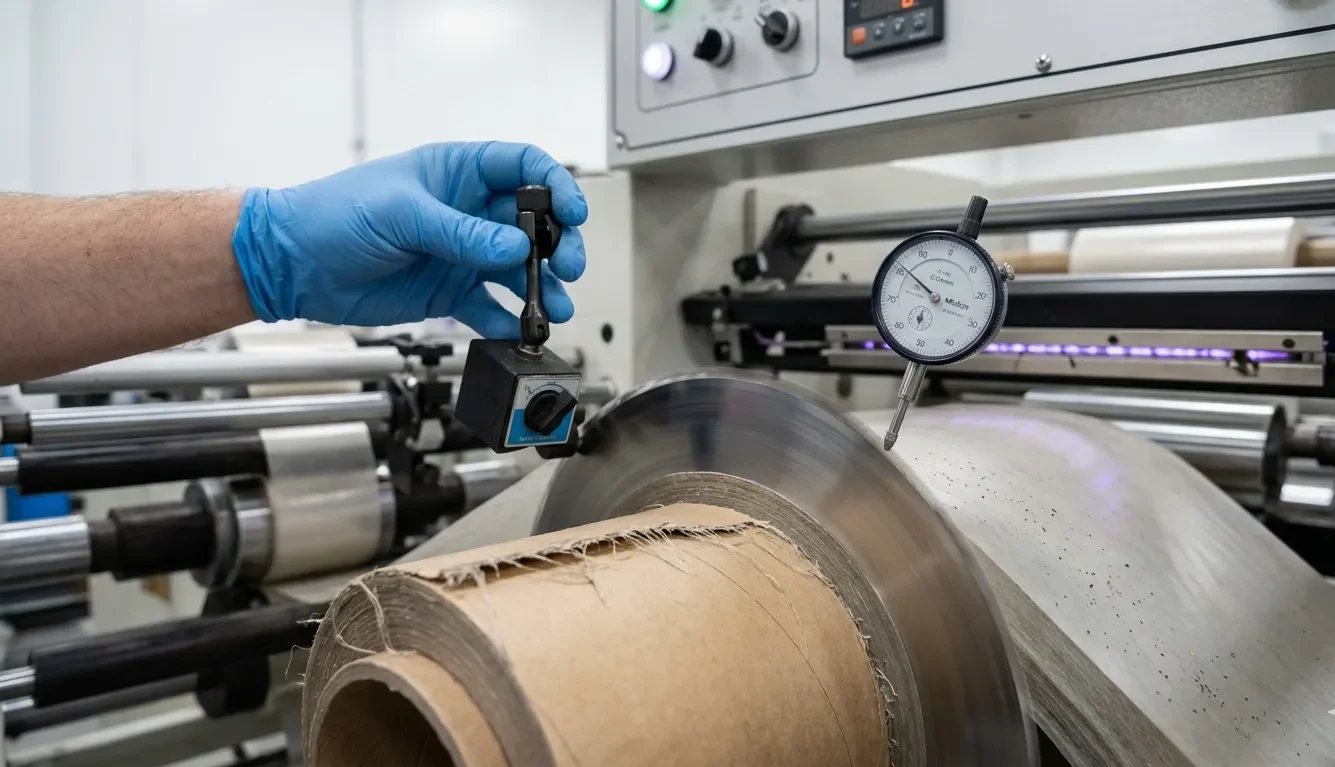
Precision is measured in microns. If your knife shaft has a “jump” or runout exceeding 0.03mm, the blade is essentially drawing a wave on the film edge at several thousand RPMs. This creates a jagged, serrated edge that looks like slitting dust.
How to Check: Attach a dial indicator to the machine frame and place the probe against the blade’s outer edge. Rotate the shaft manually. If the needle swings beyond 0.03mm, your bearings or the shaft itself are warped.
4. The Parameter “Iron Rule”
In process engineering, you can only optimize two of these three variables at once: Line Speed, Entry Angle, and Contact Pressure.
Entry Angle Strategy: A smaller angle (approaching 10°) is “slicker” for high-speed thin films. A larger angle (up to 20°) is “aggressive” for low-speed thick films.
Optimization Path: Fix the angle at 15°, then ramp up speed until the edge quality degrades. Only adjust contact pressure as a last resort, as it is the most common cause of “false positive” diagnostics.
5. Invisible Forces: Static and Thermal Friction
If your edges look “hairy” or the dust seems to cling aggressively to the roll, you are likely dealing with Static Discharge or Thermal Softening.
Static Electricity: High-speed separation can generate over 10,000V. This causes burrs to stand upright, making the defect appear worse than it is. Solution: Install ionizing bars and check the humidity (ensure it is above 40%).
Thermal Effect: Friction generates heat. If the blade temperature exceeds the material’s Glass Transition Temperature (Tg), the film edge melts and strings out. Solution: Use air-cooled knife holders or micro-mist cooling.
The Manufacturer’s Perspective
In 80% of cases, the root cause of burrs lies upstream—in coating thickness uniformity or roll profile. As a direct manufacturer with over two decades of experience, we know that high-quality slitting is a symphony of tension, chemistry, and precision mechanics.
If you have optimized these five steps and the issue persists, the problem may be in the material’s internal stress. Contact our engineering team at ppptape.com for a deeper technical audit of your industrial tape requirements.