
As electronic devices trend toward higher frequencies and extreme integration, Electromagnetic Compatibility (EMC) has shifted from a compliance check to a core product reliability challenge. Conductive foam serves as the “flexible bridge” between rigid shielding and dynamic grounding requirements. However, the difference between a high-performing assembly and a field failure often lies in the bonding technology—specifically the interplay between the foam carrier and the conductive adhesive.
1. Deciphering Technical Excellence: The Metrics That Matter
When evaluating conductive foam for high-stakes applications like 5G infrastructure or Automotive ADAS, generic specifications are insufficient. Professional-grade materials must meet the following benchmarks:
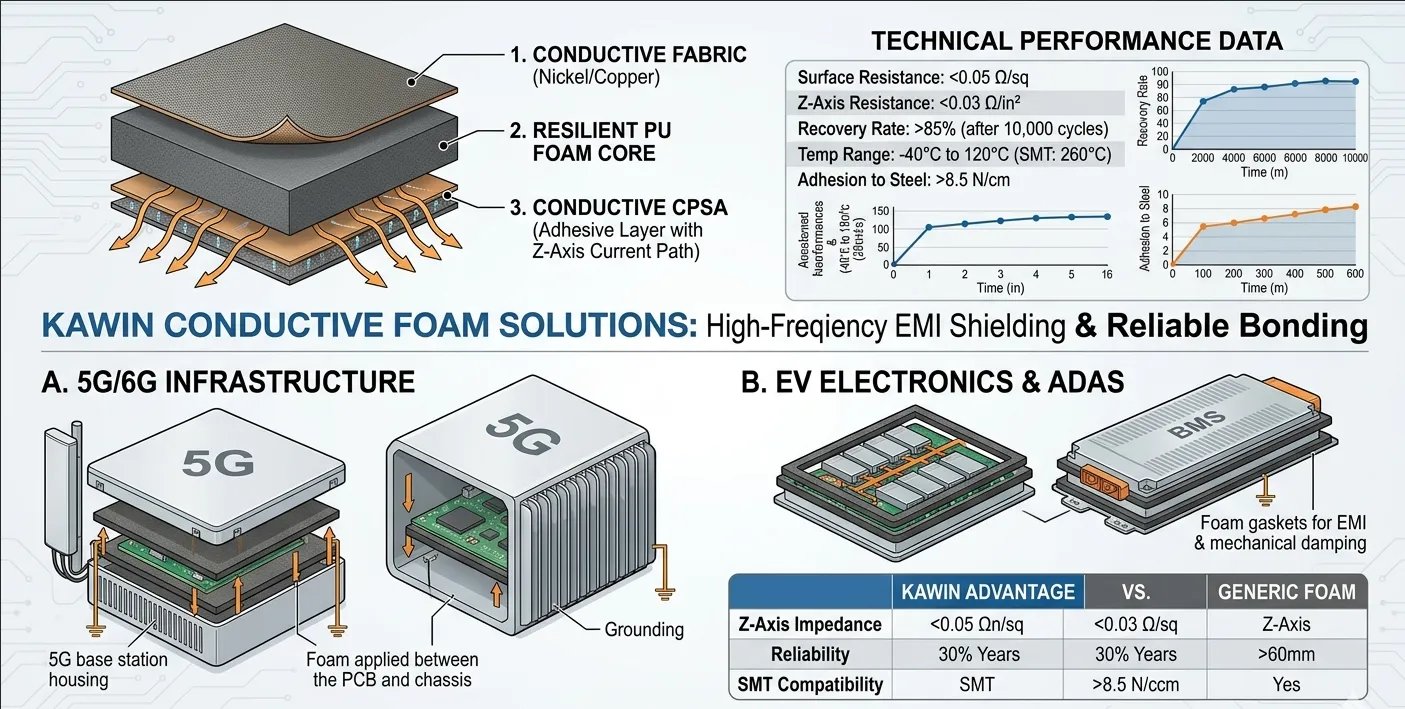
Z-Axis Electrical Conductivity: While surface resistance is crucial (typically < 0.05 Ω/□), the vertical path through the adhesive is where most EMI leaks occur. Top-tier foams utilize Isotropic Conductive Pressure Sensitive Adhesives (CPSA) to ensure a resistance path of < 0.03 Ω/in².
Mechanical Memory & Recovery: To maintain shielding under vibration, the foam must exhibit a recovery rate of ≥85% even after thousands of compression cycles.
Thermal Endurance: With the rise of high-power chips, the bonding interface must withstand short-term exposure of 260°C (SMT Reflow compatible) and long-term operating temperatures exceeding 85°C.
2. Strategic Comparison: Choosing the Right Shielding Profile
In 2026, the “one-size-fits-all” approach to EMI materials is dead. Here is how specialized foams compare:
| Material Type | Core Advantage | Best Applied In… | Technical Equivalent |
| Conductive PU Foam | High elasticity & cost-efficiency | AI PCs, Gaming Consoles | Tesa 602xx Series |
| SMT Conductive Foam | Automation-ready, Reflow stable | 5G Base Stations, IoT | 3M 5113SB / 5115 |
| Silicone-Based Foam | Extreme heat & UV resistance | EV Battery Packs, Aerospace | Nitto Conductive Series |
3. Critical Application Scenarios: Where Failure is Not an Option
A. 5G-Advanced & 6G Infrastructure
High-frequency RF front-ends require grounding solutions that minimize signal loss. Conductive foam provides a low-impedance path that cancels out parasitic capacitance, ensuring signal integrity in optical modules and macro base stations.
B. New Energy Vehicles (NEV) & ADAS
In the “Three-Electric” system (Battery, Motor, Controller), EMI foam must survive harsh thermal cycling and constant mechanical shock. Here, the Conductive Tape’s peel strength (typically >8.5 N/cm) prevents delamination that could lead to catastrophic short circuits.
C. Foldable & AI Electronics
In ultra-slim AI laptops and foldable smartphones, space is at a premium. Ultra-thin (200μm) conductive foams allow for grounding in tight hinge areas where traditional gaskets would fail.
4. The “Expertise” Edge: Solving the Galvanic Corrosion & Aging Problem
A common oversight in B2B procurement is ignoring Galvanic Corrosion. When conductive cloth (usually Nickel/Copper) meets an Aluminum housing in a humid environment, the bond can degrade.
G-Expert Insight: “Optimizing the chemical composition of the Conductive Acrylic Adhesive is key. By adding corrosion inhibitors into the PSA, we extend the shielding life by up to 40% compared to generic alternatives.”
5. Why KAWIN (加韵新材料) is the Technical Alternative of Choice
With over 29 years of expertise in industrial adhesive tape manufacturing, KAWIN specializes in bridging the gap between high-performance shielding and cost-effective B2B supply chains. Our solutions are engineered to be 1:1 technical equivalents to global leaders like 3M and Tesa, optimized for high-speed SMT assembly.
Optimize Your EMI Strategy Today
Looking for technical datasheets (TDS) or customized die-cut samples? Connect with our engineering team to ensure your next-generation device meets the highest EMC standards.