
In the rush to optimize Bill of Materials (BOM) costs, some manufacturers ask: “Do we really need dedicated thermal conductive double-sided tape? Can’t we just use mechanical fixings or cheaper adhesives?”
After 24 years of manufacturing industrial tapes for the power battery, LED, and telecommunications sectors, our answer is always the same: Skipping the thermal interface is not a saving; it is a liability. When you omit high-quality thermal tape in power electronics, EVs, or LED modules, you aren’t just saving a few cents—you are systematically introducing four categories of failure into your product’s DNA.
1. The “Air Gap” Trap: Why Thermal Efficiency Crashes
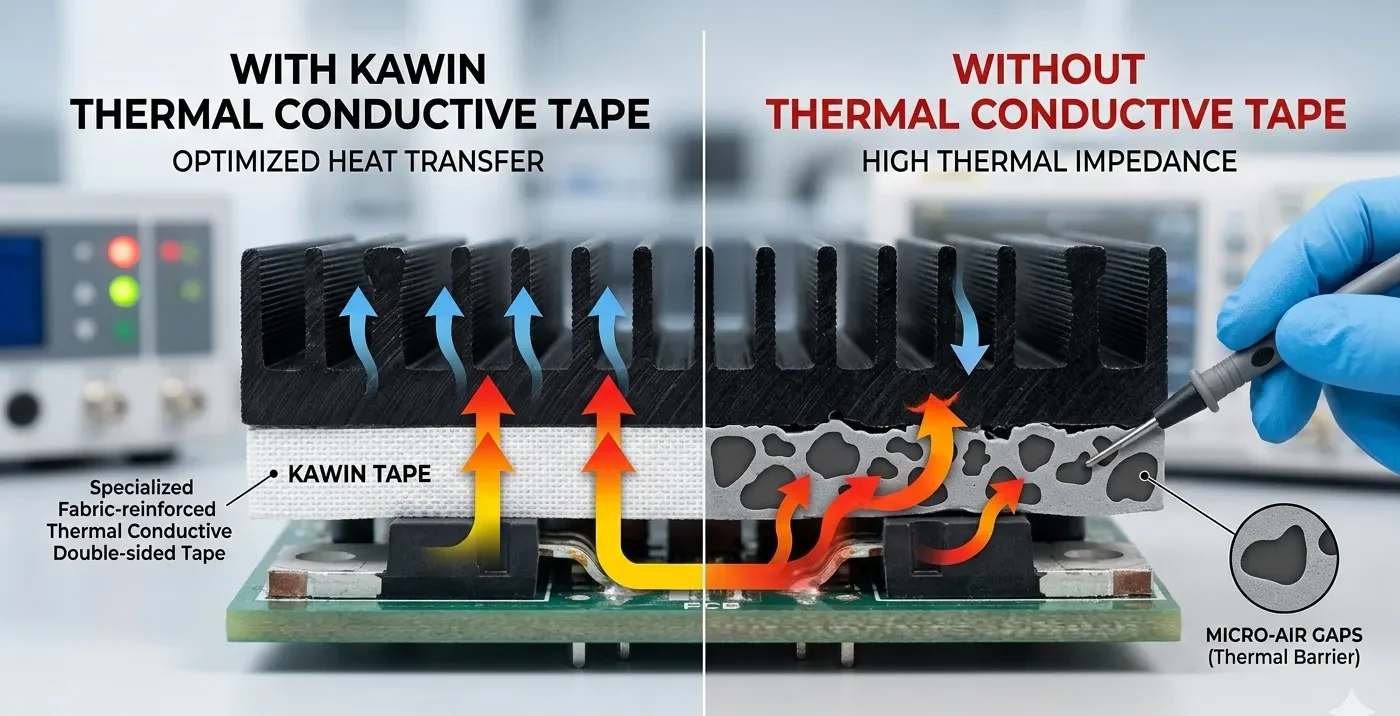
Metal surfaces, PCBs, and heat sinks may look flat to the naked eye, but at a microscopic level, they are rugged mountains and valleys.
The Problem: Without thermal tape to fill these micron-level voids, you create air gaps. Air is a disastrous conductor, with a thermal conductivity of only ~0.026 W/m·K.
The Consequence: This creates a massive “thermal wall.” In high-performance components like CPUs or power transistors, a 10°C increase in core temperature can double the failure rate. In LED lighting, this translates directly to rapid lumen depreciation and color shifting.
2. Structural Instability: Why Mechanical Fixings Aren’t Enough
Thermal conductive tape is a multi-functional hybrid: it provides heat transfer + adhesion + mechanical damping. Removing it compromises the entire assembly’s physical integrity.
Vibration & Shift: In automotive electronics (EVs) or industrial drones, vibration is constant. Without the uniform bond of a double-sided tape, components can shift, leading to intermittent contact and localized “hot spots.”
Stress Management: Mechanical screws create point stress. Thermal tape distributes loads evenly across the entire surface, protecting fragile silicon dies and PCB traces from cracking during thermal expansion and contraction (Thermal Cycling).
3. The Silent Killers: Electrical Safety & Environmental Risks
Many thermal tapes, especially those with fiberglass or polyimide carriers, serve a secondary role as electrical insulators.
Short Circuit Risk: Without an insulating thermal interface, a heat source in direct contact with a metal chassis risks electrical leakage or a full-blown short circuit.
The “Bleed” Issue: If you substitute tape with low-quality thermal grease, the grease can “pump out” over time due to thermal cycles. This migrating grease can contaminate sensor pins or connectors, leading to signal interference or corrosion.
Flame Retardancy: Professional thermal tapes are rated to UL94 V-0. Substituting them with standard adhesives can turn a minor overheating incident into a fire hazard.
4. Accelerated Aging: The “Death by Heat” Cycle
Heat is the primary enemy of electronic longevity.
Electrolytic Capacitors: Their lifespan is cut in half for every 10°C rise in ambient temperature.
Power Battery Cells: Uneven heat distribution (thermal gradients) causes cells to age at different rates, leading to premature battery pack failure or, in extreme cases, thermal runaway.
Industry-Specific Consequences of “No Tape” Designs:
| Industry | Typical Failure Outcome |
| Consumer Electronics | Throttling, lag, and battery swelling (bloating). |
| LED Lighting | Rapid brightness decay and premature “burn-out.” |
| EV Battery Packs | Thermal management failure and increased fire risk. |
| Industrial Power | Frequent downtime and precision drift in control boards. |
The Verdict: Is There Ever an Exception?
Only in extremely low-power, vibration-free, and thermally stable environments (like simple ambient temperature sensors) can you safely omit thermal interface materials.
For everything else—from EV power modules to outdoor 5G base stations—thermal conductive tape is the most cost-effective insurance policy you can buy. It ensures your product survives the warranty period and beyond.
At KAWIN (ppptape.com), we provide precision-engineered thermal solutions that balance conductivity, insulation, and bond strength. Don’t let a “cheap” alternative ruin your brand’s reputation.