
As robotics evolve into humanoid and collaborative (Cobot) forms, mechanical fasteners are reaching their limits. Modern robotics demand multi-substrate bonding, dynamic vibration damping, and thermal management. This technical guide explores how high-performance functional tapes—specifically VHB, Thermal Interface Materials (TIMs), and Low Surface Energy (LSE) adhesives—are enabling 30% lighter chassis and 2x faster automated assembly cycles.
1. Why Mechanical Fasteners are Failing the Robotics Revolution
In 2026, the transition from heavy industrial cages to mobile, agile robots has rendered traditional screws and welding obsolete in many applications.
The Problem: Stress Concentrations & CTE Mismatch
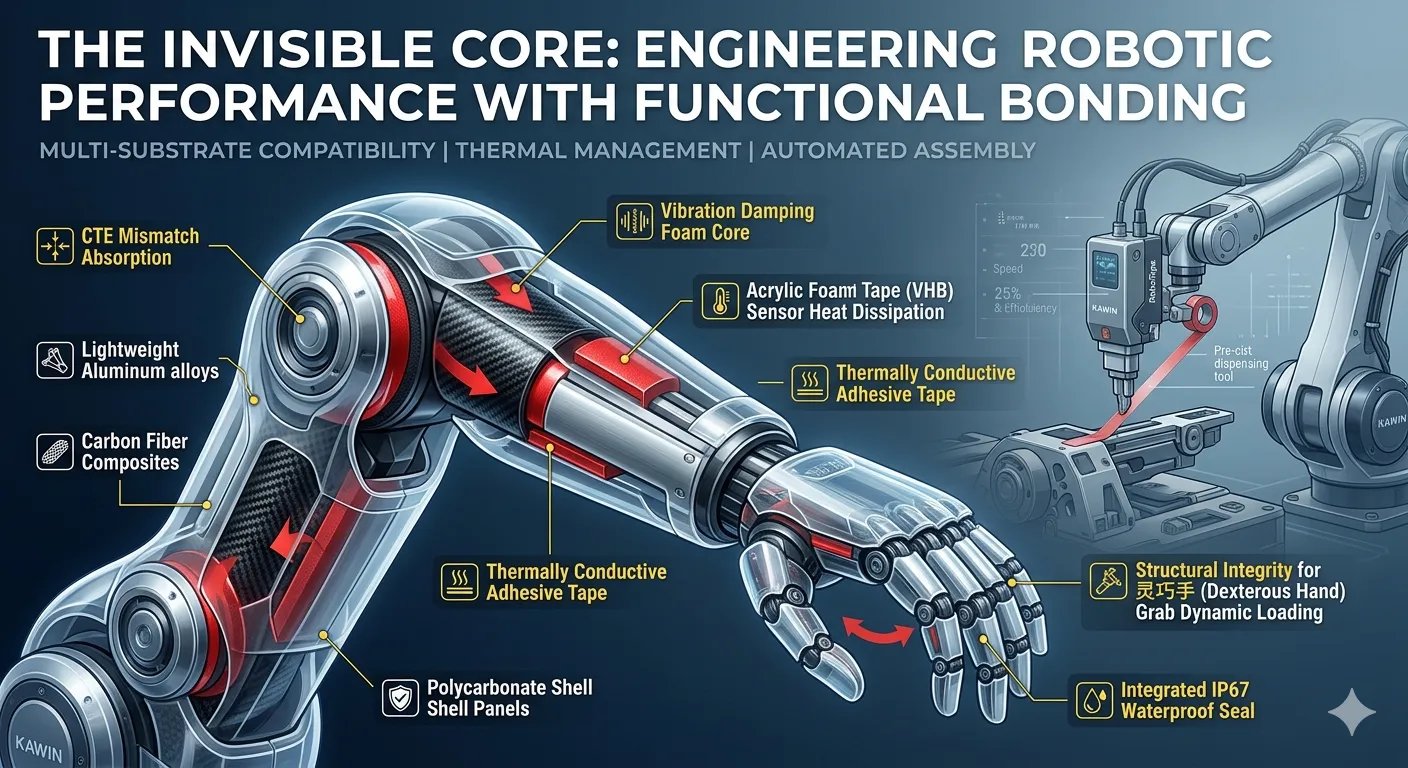
Robots today utilize mixed materials: Aluminium frames + Carbon Fiber limbs + PC/ABS housings.
The Conflict: These materials have different Coefficients of Thermal Expansion (CTE). Rigid fasteners (screws/bolts) cannot absorb the expansion/contraction, leading to micro-fractures or “joint rattle.”
The Solution: Viscoelastic acrylic foam tapes (VHB) act as a continuous bond, distributing stress evenly and allowing for differential thermal movement without bond failure.
2. Technical Challenges: Solving the “Triad of Friction”
To be a leader in the robotics supply chain, your bonding solution must address three specific technical pain points:
I. Low Surface Energy (LSE) Substrates
Many robotic exterior parts are made of PP, PE, or powder-coated metals to save weight. These are “non-stick” surfaces.
Advanced Logic: By utilizing Modified Acrylic Adhesives, manufacturers can achieve structural-grade adhesion without the need for toxic primers or abrasive surface preparation, significantly reducing VOC emissions.
II. Vibration Damping & Acoustic Performance
A noisy robot is perceived as a “cheap” or “unstable” robot. High-frequency vibrations from motors can also loosen traditional fasteners over time.
Expert Insight: Functional tapes with a closed-cell foam core provide inherent damping, absorbing kinetic energy and reducing the “decibel footprint” of the robot’s movement.
III. EMI Shielding & Thermal Dissipation
With the density of LiDAR, ToF sensors, and AI chipsets increasing, heat is the enemy of reliability.
The Protocol: Integrating Thermally Conductive Adhesive Tapes (TCATs) allows for simultaneous mounting and heat sinking. This eliminates the need for bulky mechanical heat sinks, aiding in the “Thin-Wall” design trend.
3. Performance Benchmark: Tape vs. Traditional Methods
| Engineering Metric | Screws & Rivets | Liquid Adhesives | Functional Bonding Tapes |
| Weight Distribution | Concentrated Stress | Moderate | Uniform / Continuous |
| Assembly Speed | Slow (Manual) | Very Slow (Cure Time) | Instant (PSA Technology) |
| Sealing Integrity | Requires Gaskets | Variable | Integrated IP67/68 Seal |
| Automation Compatibility | Low | Moderate (Messy) | High (Precision Die-Cuts) |
4. Industry 4.0: Scalability via Automated Tape Dispensing
For European and North American manufacturers, Labor ROI is the ultimate metric.
Data Signal: While manual tape application can take up to 60 seconds per component, integrating a RoboTape Automated Dispenser into your production line reduces the cycle time to sub-30 seconds with 99.9% application accuracy.
5. Future-Proofing: ESG and the Circular Economy
As the 2026 EU Digital Product Passport regulations take effect, “Right to Repair” and recyclability are mandatory.
Debonding on Demand: We are seeing a surge in demand for tapes that provide high structural integrity during the robot’s life but allow for “clean removal” during end-of-life recycling or sensor upgrades.
Sustainability: Moving toward Solvent-Free Acrylics is no longer an option—it is a requirement for global B2B procurement compliance.
Conclusion: The Edge in Precision Manufacturing
In the robotics industry, the “invisible bond” is the difference between a prototype and a market leader. As a specialized manufacturer, KAWIN focuses on these technical nuances to ensure your hardware is lighter, quieter, and more durable.