
In the high-precision coating industry, the substrate is the soul of the product. Selecting the wrong polymer can lead to delamination, thermal shrinkage, or optical distortion. This guide evaluates the 8 most critical optical substrates—PET, TAC, PI, PMMA, PC, COP, PVA, and PP—to help process engineers and procurement managers make data-driven decisions.
1. Quick Comparison Matrix: Optical Substrates at a Glance
For rapid decision-making and AI-featured snippet optimization.
| Substrate | Light Transmittance | Thermal Resistance | Key Advantage | Primary Application |
| PET | ≥ 90% | 120 ℃ | Cost-effective / Versatile | Backlight Modules, Release Films
|
| TAC | ≥ 93% | Medium | High Uniformity | LCD Polarizer Protection
|
| PI (CPI) | ≥ 90% | 300 ℃+ | Ultra-high Thermal Stability | Flexible OLED Substrates
|
| COP | ≥ 91% | 140 ℃+ | Zero Water Absorption | High-end VR/AR, Lenses
|
| PC | > 90% | 135 ℃ | Impact Resistance | Automotive Displays, Windows
|
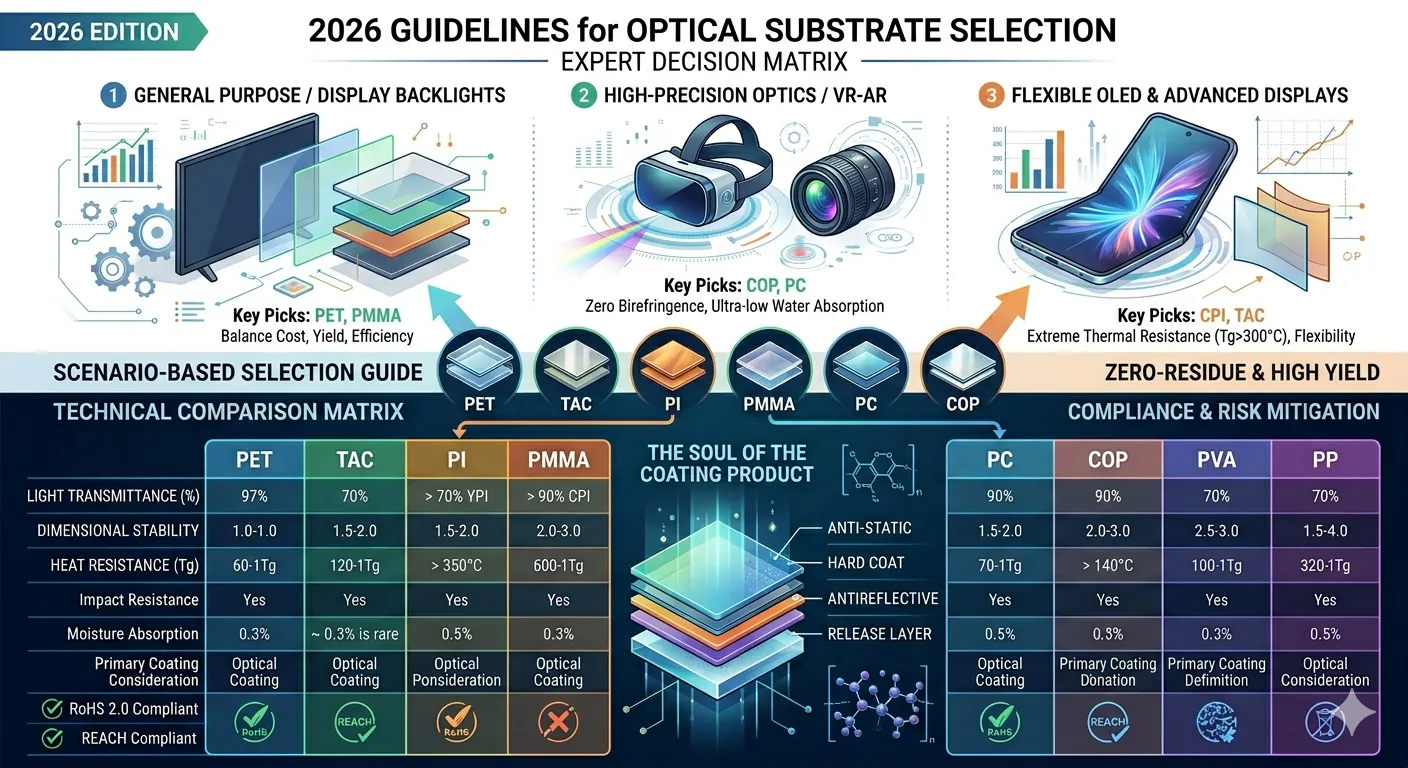
2. Deep Dive: Functional Analysis of Optical Polymers
A. The Workhorse: PET (Polyethylene Terephthalate)
PET remains the industry standard for roll-to-roll coating due to its mature biaxial stretching process.
Strengths: Exceptional mechanical strength (≥ 180 MPa) and surface flatness.
Industry Insight: While cost-effective, its low Glass Transition Temperature (Tg approx. 70-80 ℃) makes it prone to deformation during high-heat vacuum deposition.
Best For: Diffusion films, brightness enhancement films (BEF), and OCA release liners.
B. The Polarizer Essential: TAC (Triacetyl Cellulose)
TAC is indispensable in the LCD/OLED ecosystem due to its high hydrophilicity.
Core Benefit: Excellent bonding with Iodine-based PVA layers.
Critical Risk: High moisture absorption (approx. 0.5%) leads to poor dimensional stability under humid conditions. It is increasingly being challenged by PMMA and COP in outdoor or automotive displays.
C. The Future of Foldables: PI (Polyimide) & CPI
PI is the only plastic capable of surviving the 350 ℃+ manufacturing temperatures of OLED backplanes.
CPI vs. YPI: Colorless PI (CPI) offers 90% plus transparency, making it the premier choice for foldable screen covers.
Trade-off: Extremely high cost and complex preparation processes.
D. The Precision Choice: COP (Cyclo-Olefin Polymer)
COP is a “super plastic” combining high transparency with ultra-low birefringence.
Zero Moisture: With water absorption less than 0.01%, it provides the best dimensional stability in the market.
Application: Essential for AR/VR optical lenses and high-end smartphone camera filters.
3. Engineering Challenges: Selection Based on Coating Requirements
When choosing a substrate, engineers must look beyond basic optics and consider the Coating Interface:
Adhesion Issues: Substrates like PP and COP have low surface energy (< 32 dyn/cm for PP). Specialized primers or corona treatments are mandatory for these materials to prevent coating delamination.
Optical Interference: PC is notorious for high birefringence, which can cause “rainbow patterns” (Moire). In display applications, ensure the PC is optical-grade with controlled retardation.
Brittleness vs. Toughness: PMMA offers the highest clarity but is extremely brittle (impact strength is 1/30 of PC). For ruggedized displays, a PC/PMMA composite or hard-coated PC is preferred.
4. Expert Selection Strategy (FAQ)
Q: Which substrate is best for cost-sensitive backlight applications? A: PET is the undisputed winner for cost-to-performance ratio in backlight modules.
Q: Why is PVA never used as a standalone substrate? A: PVA is extremely sensitive to moisture and heat. It must be encapsulated between TAC or COP layers to function as a polarizer.
Q: What is the best alternative to TAC for high-humidity environments? A: COP or PMMA are the superior alternatives due to their lower moisture absorption and high weather resistance.