
Introduction
LED strip lights are widely used in commercial signage, architectural lighting, retail displays, industrial facilities, and outdoor illumination projects. While the lighting technology itself is highly reliable, one recurring issue continues to frustrate installers, contractors, and manufacturers:
The adhesive backing fails before the LED strip reaches its expected service life.
In many cases, the LEDs continue working perfectly while the strip itself begins peeling away from aluminum profiles, powder-coated surfaces, plastic housings, or installation channels.
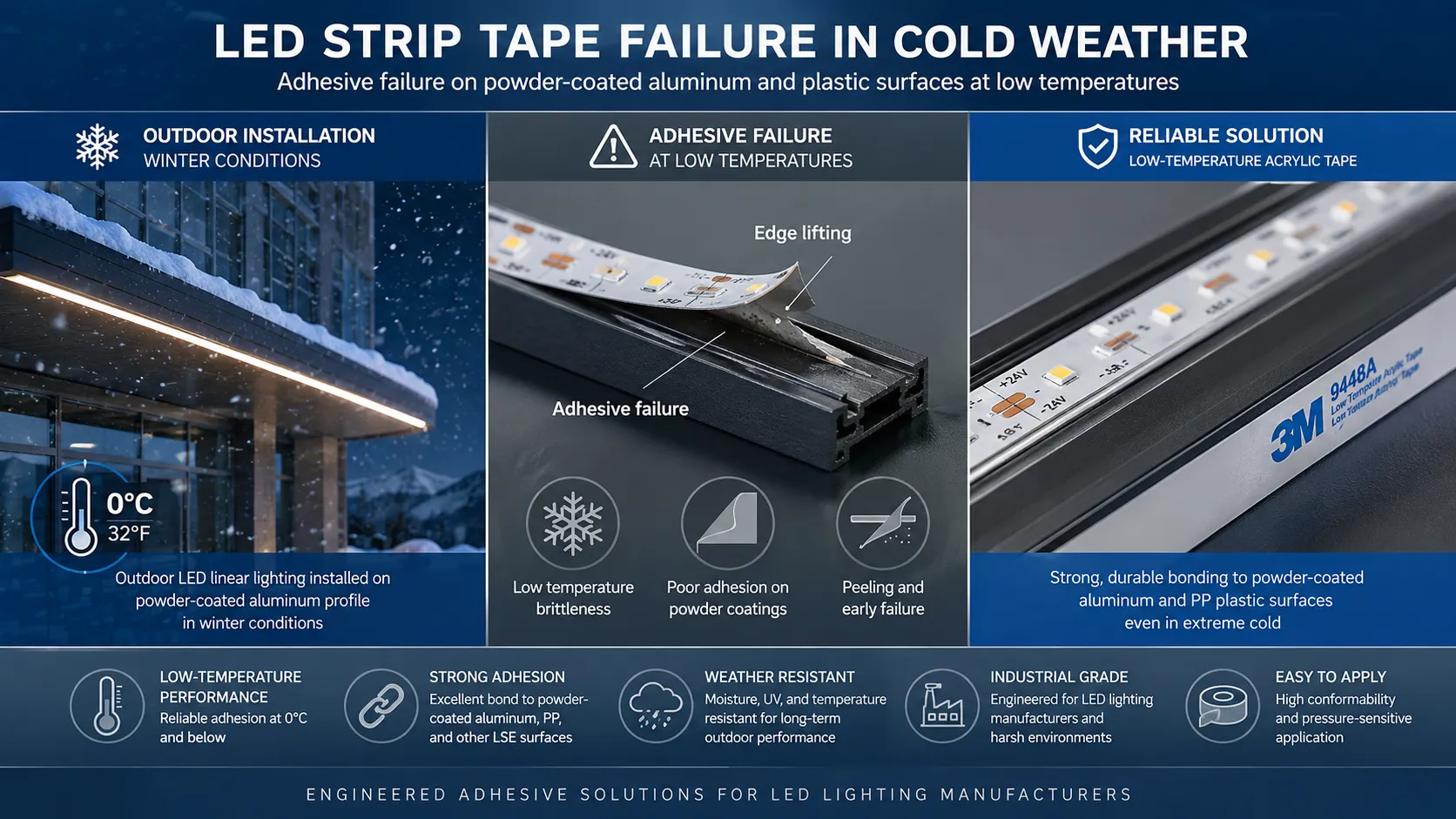
The problem becomes even more severe during winter installations and low-temperature production environments.
Understanding why LED strip adhesives fail—and selecting the right bonding system—can significantly improve installation reliability, reduce maintenance costs, and prevent warranty claims.
Why Do LED Strip Adhesives Fail?
Most adhesive failures are not caused by the LED strip itself. They are caused by a mismatch between the adhesive system and the installation environment.
The most common causes include:
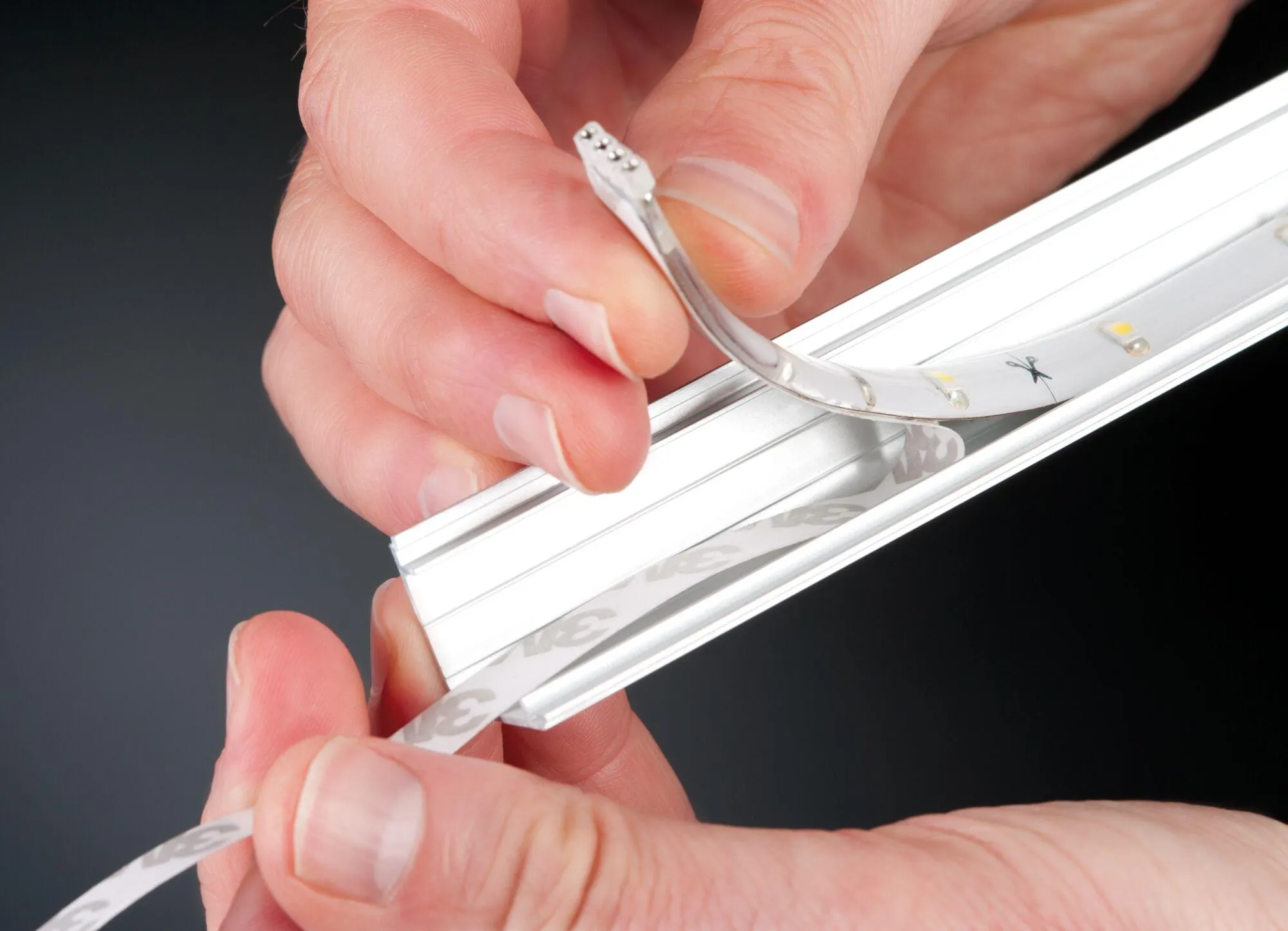
1. Low Installation Temperature
Pressure-sensitive acrylic adhesives rely on flow and wetting to create a strong bond.
When temperatures fall below approximately 10°C (50°F):
- Adhesive flow slows dramatically
- Surface wetting becomes incomplete
- Initial tack decreases significantly
- Ultimate bond strength may never fully develop
As a result, LED strips installed in winter often appear secure during installation but begin lifting days or weeks later.
2. Low Surface Energy Materials
Many modern lighting products use materials such as:
- Polypropylene (PP)
- Polyethylene (PE)
- Powder-coated aluminum
- Textured engineering plastics
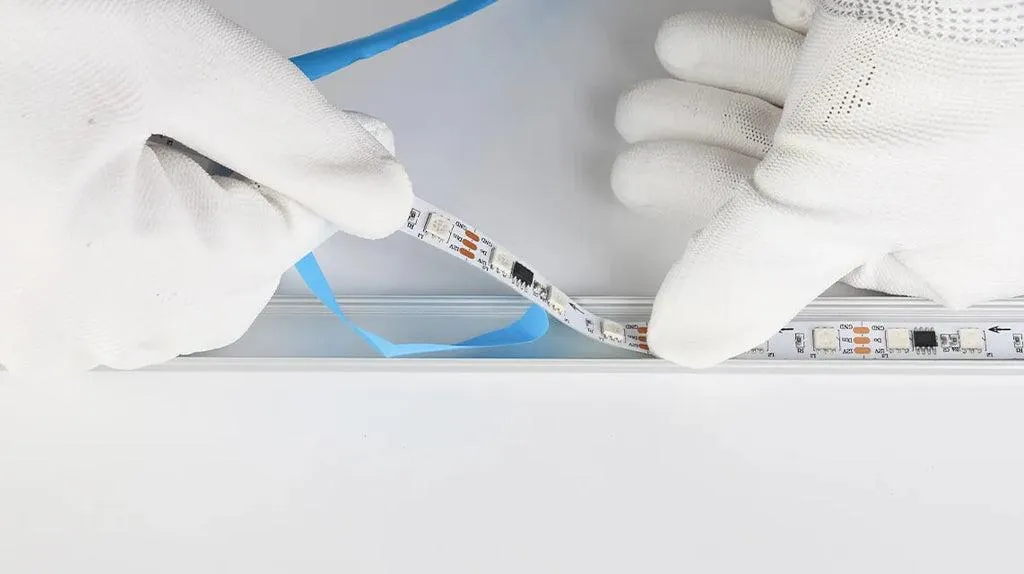
These substrates have relatively low surface energy, making them difficult for conventional tapes to wet effectively.
Without sufficient wet-out, the adhesive only contacts a portion of the surface, creating weak bonding zones that eventually fail under vibration or thermal cycling.
3. Thermal Expansion and Contraction
LED lighting systems continuously generate heat.
During operation, aluminum channels, plastic housings, and adhesive layers expand and contract at different rates.
Over time, this repeated movement creates stress at the adhesive interface.
If the adhesive lacks sufficient cohesion and flexibility, edge lifting becomes inevitable.
4. Surface Contamination
Even seemingly clean surfaces may contain:
- Dust particles
- Silicone residues
- Mold-release agents
- Machine oils
- Fingerprints
These contaminants create microscopic separation layers that prevent proper adhesive contact.
Poor surface preparation remains one of the leading causes of premature adhesive failure in LED lighting installations.
Why Standard LED Backing Tapes Often Underperform
Many low-cost LED strips use general-purpose tissue tapes designed primarily for cost reduction rather than long-term performance.
Common limitations include:
- Reduced adhesion below 10°C
- Poor performance on PP and powder-coated surfaces
- Limited resistance to plasticizer migration
- Weak aging resistance in outdoor environments
- Inconsistent liner release during automated assembly
These limitations may not be noticeable during initial installation but frequently become evident after several months of field exposure.
What Should You Look for in an LED Strip Mounting Tape?
When selecting a tape for professional LED lighting applications, several performance characteristics are particularly important.
Low-Temperature Installation Capability
For outdoor projects and winter installations, the tape should maintain strong initial adhesion at temperatures close to 0°C.
This reduces installation delays and eliminates the need for extensive surface preheating.
Reliable Adhesion to Common Lighting Materials
A suitable LED tape should bond effectively to:
- Aluminum profiles
- PC housings
- Powder-coated metals
- Engineering plastics
- Painted surfaces
This minimizes the need for multiple tape specifications across different product lines.
Compatibility with Automated Manufacturing
For high-volume LED strip production, stable liner release is critical.
Poor liner performance can lead to:
- Machine stoppages
- Feeding errors
- Increased labor costs
- Reduced production efficiency
Long-Term Resistance to Plasticizer Migration
PVC jackets and flexible lighting components often contain plasticizers.
Over time, these chemicals can migrate into the adhesive layer and significantly reduce bond strength.
A properly formulated acrylic adhesive system helps maintain long-term performance in these environments.
A Practical Solution for LED Strip Manufacturers
One example of a tape designed specifically for LED strip applications is 3M 56415F.
Its construction combines:
- Acrylic pressure-sensitive adhesive
- Tissue carrier
- PCK release liner
- Thin 150 μm profile
This design addresses several of the most common LED assembly challenges.
Key advantages include:
- Installation capability down to 0°C
- Reliable bonding to aluminum and PC substrates
- Improved performance on PP and powder-coated surfaces
- Stable processing in automated assembly lines
- Solvent-free manufacturing process
- Compliance with RoHS and REACH requirements
For manufacturers operating in cold climates or supplying outdoor lighting systems, these characteristics can significantly improve installation reliability.
Best Practices for Maximum Bond Performance
Even the highest-performing tape can fail if installation procedures are ignored.
For best results:
- Clean all bonding surfaces using IPA-based cleaners.
- Remove dust, oils, and processing residues.
- Apply firm, uniform pressure during installation.
- Allow at least 24 hours dwell time before maximum loading.
- Store tape under recommended temperature and humidity conditions.
Following these practices often has as much impact on bond reliability as the tape selection itself.
Conclusion
LED strip adhesive failure is rarely caused by a single factor.
In most cases, failure results from a combination of:
- Low installation temperatures
- Challenging substrate surfaces
- Thermal cycling
- Surface contamination
- Inadequate adhesive selection
By understanding these root causes and selecting an adhesive system specifically designed for LED lighting applications, manufacturers and installers can dramatically improve product reliability and reduce field failures.
For projects involving cold-weather installation, powder-coated surfaces, or automated production environments, choosing the correct mounting tape is often the difference between a successful installation and a costly warranty claim.