
Executive Summary: The thermal conductivity ($\lambda$) of a flexible gap pad is not a static constant. It is a dynamic property determined by material formulation, internal structure, and application pressure. For engineers and procurement managers, understanding the ASTM D5470 standard is essential for accurate thermal management.
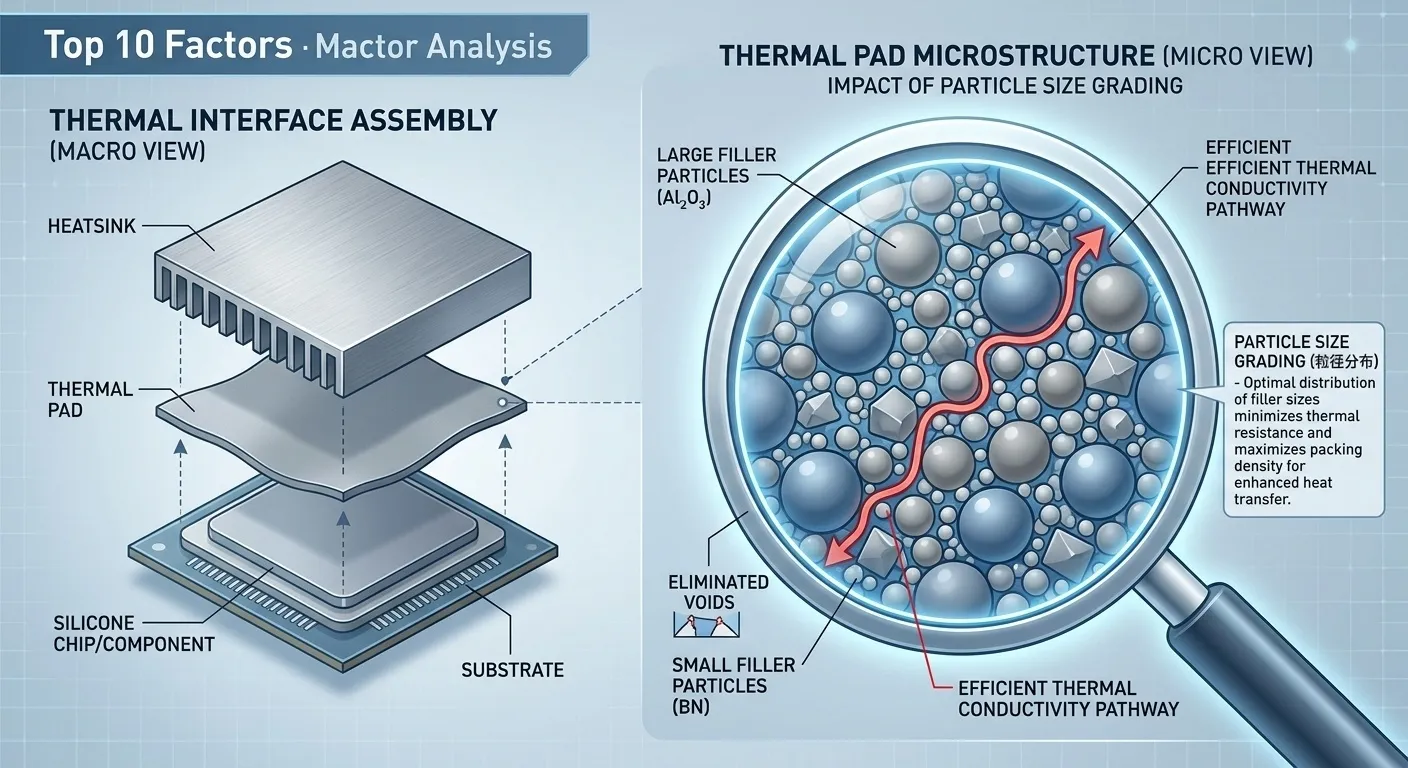
I. Top 10 Factors Influencing Thermal Conductivity
In industrial manufacturing, the “advertised” W/m·K is only part of the story. Here is what truly dictates performance:
1. Filler Type & Chemical Composition
The “engine” of heat transfer.
Alumina ($Al_2O_3$): Cost-effective, typical for 1–3 W/m·K applications.
Aluminum Nitride (AlN): High performance, used for 3–8 W/m·K solutions.
Boron Nitride (BN): Premium filler offering high conductivity with superior dielectric insulation.
2. Filler Loading (Filling Ratio)
The higher the density of particles, the more continuous the thermal path. Most high-performance pads feature a loading rate between 60% and 90%.
3. Particle Size Distribution (Grading)
By using a “Graded” mix (large particles combined with small particles), micro-voids are filled, creating a more efficient thermal bridge within the polymer matrix.
4. Matrix Material (The Skeleton)
Typically silicone or non-silicone rubber. The matrix’s Shore Hardness determines how well the pad “wets” the heat sink surface, which is critical for reducing interfacial resistance.
5. Internal Orientation & Anisotropy
Isotropic: Heat flows evenly in all directions.
Anisotropic: Fillers are aligned (often via magnetic or mechanical means) to boost conductivity significantly in the Z-axis.
6. Assembly Pressure (The Variable Factor)
This is a critical real-world factor. Higher pressure = thinner pad + tighter particle contact = higher effective conductivity.
7. Material Thickness vs. Thermal Resistance
While $\lambda$ (conductivity) is a material property, $R_{th}$ (thermal resistance) depends on thickness. A thinner pad always results in better heat transfer, provided it maintains surface contact.
8. Operating Temperature
Conductivity typically increases slightly with temperature (within -40°C to 150°C) as polymer chains soften and filler contact improves.
9. Interfacial Compliance (Wetting)
The “softness” of the pad allows it to fill microscopic air gaps on the CPU or heat sink. Air is an insulator (0.026 W/m·K), so eliminating it is more important than the pad’s bulk conductivity.
10. Manufacturing Precision
Homogeneity in mixing and the complete removal of micro-bubbles (via vacuum degassing) ensure consistent performance across the entire sheet.
II. How is Thermal Conductivity Tested?
For flexible materials, the industry “Gold Standard” is the ASTM D5470 (Steady-State Heat Flow Method).
Comparison of Testing Methodologies
| Method | Industry Use | Pros & Cons |
| ASTM D5470 | Production & QC | Pros: Simulates real-world pressure. Cons: Time-intensive. |
| Laser Flash (LFA) | R&D / Material Science | Pros: Extremely fast and precise. Cons: Ignores interface resistance. |
| Hot Wire Method | Quick Screening | Pros: Portable and low cost. Cons: Hard to control compression. |
The Mathematical Foundation
Under ASTM D5470, thermal conductivity is derived by measuring thermal resistance ($R$) at multiple thicknesses ($d$) to eliminate the influence of contact resistance:
III. The Professional Testing Workflow
To ensure the reliability of ppptape.com products, we follow a rigorous ASTM D5470 protocol:
Sample Preparation: Precision-cut 25mm discs or 50x50mm squares.
Compression Control: Applying standard loads (e.g., 0.2 MPa / 30 psi) to simulate industrial assembly.
Steady State Stabilization: Heating the source until the temperature gradient stabilizes (typically < 0.1K fluctuation).
Data Modeling: Plotting the Resistance-Thickness curve to extract the absolute $\lambda$ value.
IV. Technical Checklist: How to Read a Datasheet
When comparing suppliers, a “5.0 W/m·K” rating is incomplete without the following context:
Test Standard: (e.g., ASTM D5470)
Applied Pressure: (Was it tested at 10 psi or 50 psi?)
Sample Thickness: (Standardized at 1.0mm?)
Hardness: (Shore 00 vs. Shore A)
KAWIN’s Industry Insight: In low-pressure applications, a softer pad (low Shore 00) with a conductivity of 3.0 W/m·K often outperforms a hard pad with 5.0 W/m·K. Why? Because the soft pad eliminates the “Thermal Barrier” of air at the interface. Always prioritize compliance over raw W/m·K numbers if your clamping force is limited.